Researched September 2026 from the published scorecard and Rosapenna's own course notes
St Patrick's Links is the course American golfers now ask us about before they ask about Ballybunion. That is new. Five years ago it did not exist. Tom Doak took a stretch of dunes south of the original Rosapenna courses, land that had carried two separate eighteens since the 1990s, and decided it should hold one. The result opened in 2021, and Rosapenna now quotes GOLF Magazine placing it 44th in the world. It is a par 71 of 6,930 yards from the back tees, it is walking only, and it sits three miles from the hotel front door. Everything below is about how to play it well on your first and probably only visit.
What Doak Actually Built
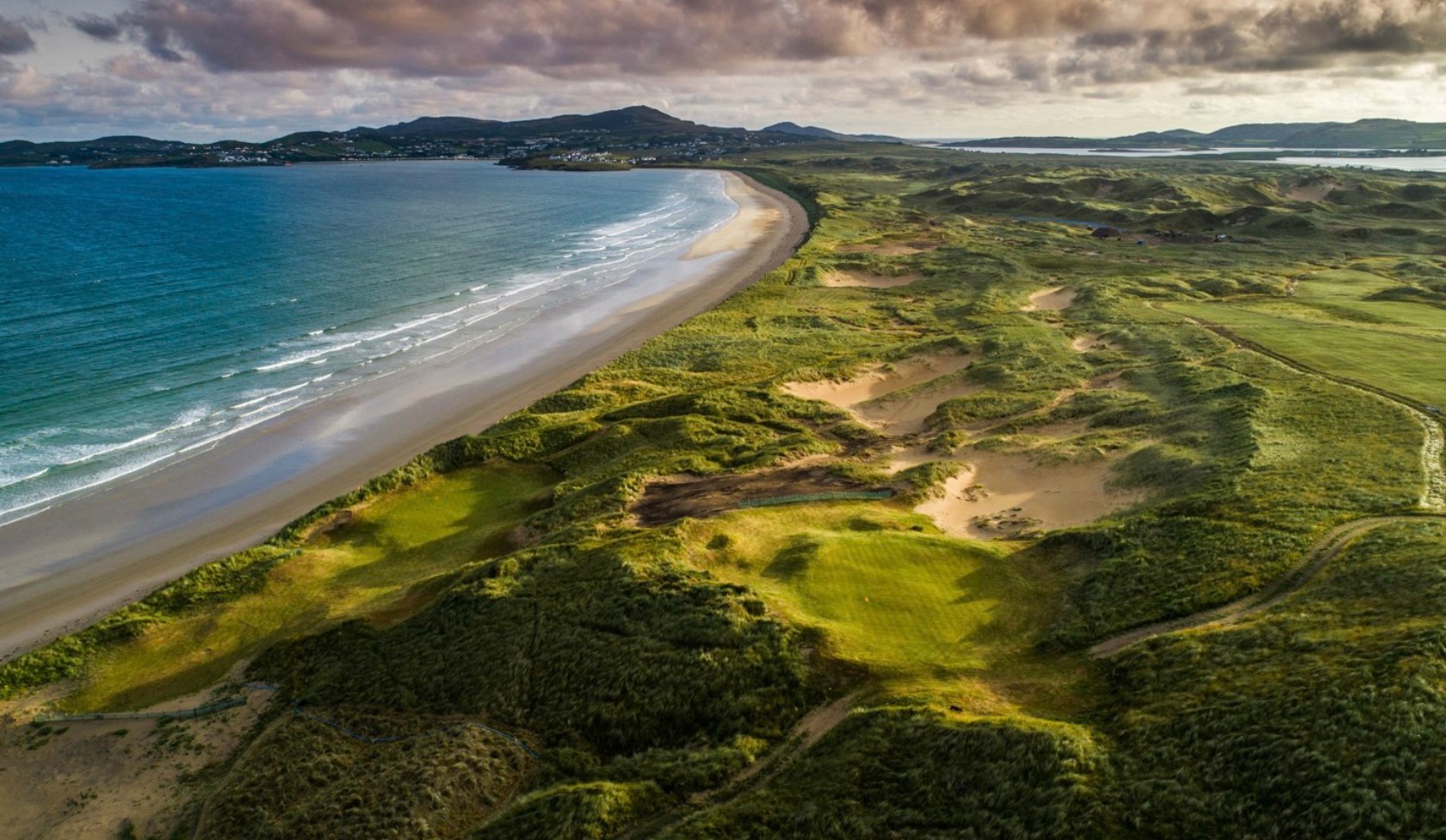
The ground here had been two courses: the Maheramagorgan, routed by Eddie Hackett, and the Trá Mór. Neither lived up to the land, and a redevelopment in 2006 stalled. When Doak saw the site he argued for one great eighteen instead of two lesser ones, and the Casey family, who own Rosapenna, agreed. Golf Digest describes the finished routing well: each nine moves out through channels in the dunes toward the shore, on broad, bouncy fairways that tilt into greens set either in hollows or up on exposed bluffs.
What that means for you is simple. The fairways are wider than they look from the tee, and the difficulty lives around the greens. Doak's firm builds courses that are playable, walkable and fun, in Rosapenna's own words, and a mid handicap who keeps the ball on the ground and accepts the odd bogey will enjoy this more than almost any championship links in Ireland.
We think the most useful way to hold the course in your head is as two walks out to the sea and two walks back. Each nine leaves the higher ground, drops through the dunes toward Sheephaven Bay and returns. You will feel the wind change direction several times in a nine, which is the whole reason the routing works, and the reason the first four holes are no guide at all to how the rest of the round will play.
Choose The Right Tees
There are four sets. Sandstone plays 6,930 yards, Slate 6,490, Granite 5,919 and Claret 5,136, all par 71. Unless you play off single figures, play the Slate. The extra four hundred yards from the Sandstone go mostly into long par fours that become three shot holes into a wind, and they add time without adding pleasure.
We say this every time an American group asks, and we will say it here: the course was built to be enjoyed from the middle tees. Doak's own rule of thumb, quoted by Rosapenna, is that if you have time to check your phone between holes he has got the routing wrong. The walks from green to tee are short. Moving back a set makes them longer and turns a brisk four hour round into a slow one, and on a links that is walking only, that time is paid for in your legs on the back nine.
A note on accuracy: yardages here are from the published card. Tee boxes on a young links do move. Confirm on the day with the starter.
The Front Nine: Out Toward The Water
The card opens with two par fours, the 1st at 381 yards and the 2nd at 372, and the 2nd is where the big dunes first appear. Take them as settling holes. The 3rd is a 178 yard par three, the first of four short holes, and the 4th, Trá Mór, is a 555 yard par five.
The 5th, Monk's Bay, is a 214 yard par three with a very large bunker guarding the green, and it is the shot on the front nine most likely to cost you two. Aim away from the sand and take the long putt. The 6th is the second par five at 571 yards, followed by the 7th, a 417 yard par four. The 8th, Horn Head, is the shortest par four on the card at 339 yards, a hole where a long iron off the tee is usually the smarter play. The nine closes with High Glen, a 460 yard par four that is the longest par four on the outward half. The front nine totals 3,487 yards, par 36.
Our advice on the front nine is to be patient with the two par fives. At 555 and 571 yards from the back, and still over 500 from the Slate, neither is reachable in two for most visitors into any breeze. Plan them as three shot holes, put the second where the third is simple, and save the aggressive swing for the 7th and the 9th, which are the two long par fours that will decide your score going out.
The Back Nine: Mountains And A Short Finish
The inward half is par 35 and 3,443 yards. It opens with the 10th, Glenveagh, at 412 yards, and the 11th at 472 yards, which from the back tees is a genuine test. The 12th, Errigal, named for Donegal's highest mountain, is the last par five at 560 yards. The 13th and 14th are mid length par fours of 376 and 399 yards, the 14th named for Sheephaven Bay itself.
Then the course changes tempo. The 15th is only 130 yards, the shortest hole on the card. The 16th, Finver, is a 534 yard par four that plays as the hardest hole on the inward half for most visitors. Treat it as a par five and you will walk off happy. The 17th, Lough Salt, is a 199 yard par three, and the round ends on the 18th, St Patrick's, a 361 yard par four that gives back a shot if you have any left.
The shape of the inward half matters for how you pace yourself. Three of the last four holes are either very short or very long: the 130 yard 15th, the 534 yard 16th, the 199 yard 17th. If you arrive at the 15th tee level with your target, you can afford to play the 16th as a five and the 17th to the fat of the green. We would rather you walked off the 18th with a story than a scorecard ruined by chasing one number.
The Four Short Holes
St Patrick's has four par threes and they are the clearest window into the course's character. From the Slate tees the 3rd plays 167 yards, the 5th 153, the 15th 125 and the 17th 176. None of them asks for a heroic carry at those lengths. What they ask for is a decision about where the ball should land and what it will do after it lands, because on firm links turf the green is rarely the only target.
Our honest advice is to play every one of them to the middle of the green and take your two putts. On the 5th that means ignoring the flag entirely and keeping well away from the large bunker that guards the green. On the 15th, the shortest hole on the card, you will be tempted to go at the pin with a short iron. Ask your caddie first. Short par threes on exposed dune ground are often the holes where a wind you did not feel on the tee takes the ball somewhere you did not intend.
Walking, Caddies And Wind
St Patrick's is walking only. Rosapenna does not allow drive buggies on it, with or without a medical certificate. If walking eighteen holes of dunes is a question for anyone in your group, book them on Sandy Hills or the Old Tom Morris Links that day, where buggies are available, and meet at the bar.
Take a caddie. Rosapenna lists the caddie fee at €90 per bag plus gratuity, paid directly to the caddie, and caddies are requested rather than guaranteed, so ask when you book the tee time. On a course this young, a local caddie is the only reliable source of lines on the blind shots and of how the greens release. The wind off Sheephaven Bay decides how the two nines play against each other, and it can turn the 16th from a long par four into an impossible one.
Before The First Tee
Three practical things will make your round better, and none of them is about technique. First, get to the course early. St Patrick's is three miles from the hotel and Rosapenna does not run a shuttle, so allow for the drive, the car park and the walk to the first tee. Second, carry less. On a walking only course, a light stand bag or a caddie makes the difference between a round you enjoy and one you endure. Rosapenna lists push trolleys at €6 a day and electric trolleys at €25 a round if you prefer to pull your own.
Third, dress for four seasons. Donegal weather turns quickly, and we would never walk onto a links on this coast without waterproofs in the bag, whatever the forecast said at breakfast. If you have not packed for it, our guide to what to bring for Irish golf covers it, and the Rosapenna golf shop will have what you forgot. Then take a breath on the 1st tee, look around, and remember you came a very long way for this walk.
How We Would Play It Once
If you only ever play St Patrick's once, and for most Americans that is the honest expectation, here is how we would do it. Book a mid morning tee time on the first full day of the trip, not the day you arrive. Play the Slate tees. Walk with a caddie and ask them for a line on every tee shot you cannot see the landing area for. Play the par fives as three shot holes, play the par threes to the middle, and treat the 16th as a par five whatever the card says.
Then do the thing most visitors forget to do: stop on the higher tees and look. The course was built on land big enough for two courses so that each hole could sit in its own space, and the views across Sheephaven Bay are part of what you paid for. We would rather you finished two shots over your handicap having seen all of it than one shot better having seen none of it. That is how we play St Patrick's, and it is how we would play it again.
Questions we get asked
- What par and length is St Patrick's Links?
- St Patrick's Links is a par 71. It plays 6,930 yards from the Sandstone tees, 6,490 from the Slate, 5,919 from the Granite and 5,136 from the Claret, according to the published scorecard.
- Who designed St Patrick's Links and when did it open?
- Tom Doak designed it on dunes that had carried two older courses since the 1990s. Work began in 2019 and the course opened in 2021 as a single eighteen on land big enough for two.
- Can you take a golf cart on St Patrick's Links?
- No. Rosapenna states that St Patrick's Links is walking only and that drive buggies are not permitted, with or without a medical certificate. Buggies are available on the resort's other courses.
- Do I need a caddie at St Patrick's Links?
- We recommend one on a first visit. Rosapenna lists caddies at €90 per bag plus gratuity, paid directly to the caddie. They are requested rather than guaranteed, so ask when you book.
- Which tees should a visiting American play at St Patrick's?
- Most visiting golfers above single figures should play the Slate tees at 6,490 yards. The Sandstone tees add length to long par fours without adding much enjoyment into a Donegal wind.
- How far is St Patrick's Links from the Rosapenna Hotel?
- About three miles, or five kilometres, from the hotel's main entrance. Rosapenna does not run a shuttle, so you need a car or a driver to reach the first tee.
How we checked this
Further reading from the Notebook