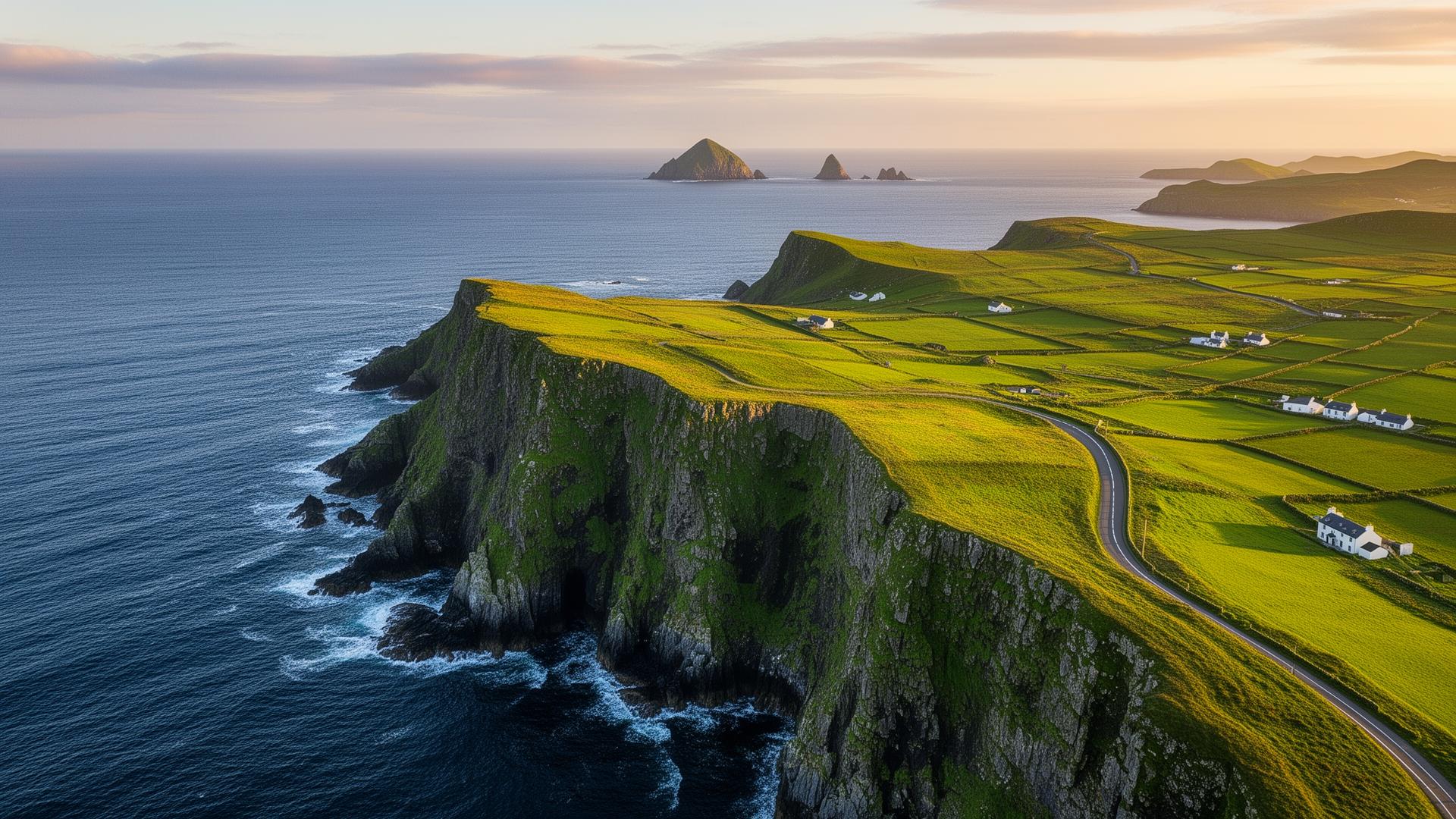
We built this route the way we build one for family coming over. East to west on the train, no more than one travel leg a day, an empty arrival evening, and the best day of the week saved for the end because it is the one that changes what people think Ireland can be.
The grades used below are ours, published in full on the hub page. A1 means independent and step free. A2 means one named obstacle. A3 means we would not send you, and we tell you where to go instead.
Every place named here also carries the four line practical checklist: best entry point, steps and ramps, restrooms, seating. Paths are checked on the hub, and the hotels, restaurants, pubs and attractions are checked on their own guides.
- Day 1Access grade A1, IndependentDublin
Land, and do nothing
The most important day of the week is the one with nothing in it.
Moving. Dublin Airport to the city, 25 minutes by accessible taxi
Every accessible Ireland itinerary I have seen puts a walking tour on the arrival afternoon and every one of them is wrong. Between the flight, the assistance handover at Dublin Airport and the twenty minutes it takes to confirm your chair came off the aircraft in the condition it went on, the day is spent. Plan for that and it is a pleasant day. Plan against it and it is the day the trip started badly.
Book the accessible taxi in advance by phone rather than through an app. Get to the hotel, get the chair checked, and then go and sit somewhere with a view of Dublin doing its evening. That is the entire brief.
- Airport
- Request special assistance with the airline at least 48 hours out and confirm at check in. Dublin's service takes you to the taxi rank, not just to reclaim.
- Transfer
- Pre-booked wheelchair accessible taxi. Roughly 25 minutes to the city outside peak.
- Evening
- Hotel dining or a level-door restaurant within two hundred metres. Nothing further.
The call. Do not schedule anything. If the day goes well you will have a free evening in Dublin, which is not a punishment.
Stay. The Marker·Eat. Grand Canal Dock, where everything was built after 2005 and everything is level
- Day 2Access grade A1, IndependentDublin
Georgian Dublin, on the flat side
The trick to Dublin in a chair is knowing which half of it is cobbled.
Moving. City only. Luas and level pavement
Dublin has two surfaces. There is the Georgian and Victorian city, which is broad pavement, dropped kerbs and level doors, and there is the medieval city, which is setts, thresholds and Temple Bar. Today is entirely the first one, and it turns out to contain almost everything worth seeing.
Start on the Grand Canal towpath from Baggot Street, which is two and a half flat kilometres of red brick and lock gates with a coffee at each end. Then Merrion Square, then the National Gallery, which is fully lift served and free. In the afternoon, the Guinness Storehouse, because seven floors of lifts ending in the only unobstructed view of the city is a genuinely great accessible visit and I will not be embarrassed about recommending it.
The Luas tram is the quiet advantage here. Level boarding at every stop, no ramp, no notice, no conversation with anybody. If your hotel is near the line you can move around this city entirely on your own terms, which is not something you can say in most European capitals.
- Morning
- Grand Canal towpath, Baggot Street to Portobello. Graded A1, sealed and level, dropped kerbs at every lock crossing.
- Midday
- National Gallery of Ireland. Step free entry on Clare Street, lifts to all floors, accessible toilets.
- Afternoon
- Guinness Storehouse with timed entry. All seven floors lift served.
- Skip
- Temple Bar. Cobbles, thresholds and basement toilets. There is nothing there you cannot get better elsewhere.
The call. Book Guinness timed entry. Not for the queue, for the gradient. The approach on Market Street slopes and forty minutes waiting on it ends the day early.
Stay. The Marker·Eat. Grand Canal Dock again, or a large Victorian pub on the south side with a level door
- Day 3Access grade A2, Assistance advisedKilkenny
South by rail to Kilkenny
The first real test, and Irish Rail passes it.
Moving. Dublin Heuston to Kilkenny, 1 hour 40 by train
This is the day people are nervous about and it is the day that converts them. Heuston is staffed, level and used to this. Book the wheelchair space when you book the ticket, give twenty four hours notice for the ramp, and somebody will be standing on the platform when the doors open. On the way down the country flattens into the Barrow valley and you understand why the Normans stopped here.
Kilkenny is medieval, which means the Medieval Mile is genuinely bumpy. Do not fight it. The castle side is the newer pavement, the parkland is sealed the whole way, and the rose garden is level. Take the lower half of the Mile, take your time, and leave the round tower at St Canice's alone, because it is a ladder inside a stone cylinder and it is not happening.
- Train
- Reserve the wheelchair space at booking. Two per intercity set and they go on Fridays.
- Afternoon
- Kilkenny Castle parkland and rose garden, graded A1. Lift access covers most of the interior and staff will tell you which rooms it misses.
- The Mile
- Graded A2. Original setts in stretches and one real climb toward St Canice's. Companion advised.
- Parking
- The Ormonde Street multi-storey has lift access if you are driving rather than training.
The call. Stay at Hunter's Yard at Mount Juliet rather than the Manor House. The newer wing is level throughout and the estate roads are sealed, which means the grounds are actually usable rather than decorative.
Stay. Mount Juliet Estate·Eat. The Parade side of Kilkenny, where the restaurant doors are level
- Day 4Access grade A1, IndependentCork city
Cork, and the easiest great meal in Ireland
A city built on a marsh, which for once is good news.
Moving. Kilkenny to Cork Kent, about 2 hours 30 by rail via Limerick Junction
Cork sits on the flat, on an island in a river, and the centre is a grid rather than a maze. After Kilkenny it feels like the city was designed by somebody sympathetic. The English Market is the anchor: level tiled floor throughout the ground level, wide aisles if you go before eleven, an accessible toilet inside the building and a lift to the gallery restaurant above.
Go at half nine. By one o'clock the aisles are a scrum and the whole advantage disappears. Eat upstairs looking down at it, which is the best twenty euro lunch in the country and one of the few times in Ireland that the accessible route has the better view.
The afternoon is deliberately soft. Cork is a walking city and the pleasure is the walking, or the wheeling, along the Lee. Save the energy. Tomorrow is the long one.
- Morning
- English Market, graded A1. Ground level flat throughout, accessible toilet inside, lift to the gallery.
- Lunch
- The gallery restaurant above the market. Book or go early.
- Afternoon
- The Lee quays and the university grounds, both level and both unhurried.
- Parking
- Accessible bays on Grand Parade, two minutes from the market entrance.
The call. Hayfield Manor for the night, because in Cork the thing that matters is parking at the door and a country house inside the city is the only place that gives you both.
Stay. Hayfield Manor·Eat. The English Market gallery at lunch, then somewhere level on Princes Street
- Day 5Access grade A2, Assistance advisedKinsale, then Killarney
Kinsale, and the drive west
This is the day to hand the driving to somebody else.
Moving. Cork to Kinsale, 40 minutes. Kinsale to Killarney, about 2 hours by accessible vehicle
West Cork and Kerry are where public transport stops being the answer, and where a wheelchair accessible vehicle with a driver earns its cost for the week. The roads narrow, the walls close in, and the difference between a beautiful drive and a stressful one is who is holding the wheel.
Kinsale in the morning is a harbour town with a sealed promenade along the water, and you should do exactly that and no more. The Scilly walk beyond the point tilts toward the water with a camber that stops being pleasant quickly. Turn around where the surface changes. The view does not improve after that.
Then west. The road to Killarney is the moment the trip changes register: farmland gives way to mountain and the light goes long. Arrive in the evening, do nothing, and let tomorrow be the good one.
- Morning
- Kinsale harbour front, graded A2. Sealed promenade for about 1.5 km before the camber starts.
- Parking
- Accessible bays at the Pier Road car park with an accessible toilet on site.
- Transfer
- Wheelchair accessible vehicle with driver. Book three months out for summer.
- Skip
- Charles Fort. Star fort on a hill, grass ramparts, and no realistic route.
The call. Book the accessible vehicle with a driver for days five, six and seven as a block. Splitting it across single days costs more and you lose the driver who already knows how your ramp works.
Stay. Killarney Park Hotel·Eat. Killarney town, where a coach-built main street means level doors almost everywhere
- Day 6Access grade A1, IndependentKillarney
Muckross, the lake and the mountain wall
The best afternoon of the week, and it is fully accessible.
Moving. Ten minutes from Killarney town
If you take one thing from this guide, take this. Muckross House sits in gardens where sealed and compacted paths run all the way to the shore of the lake, with Torc and the Reeks rising directly across the water. Accessible parking at the house, accessible toilets at the house and at the garden restaurant, and a level route between them.
There is no compromise in this day. It is not the accessible version of Kerry, it is Kerry, and the people who walked in from the car park see exactly what you see. That is rarer than it should be and it is the reason we end the route here rather than starting with it.
Torc Waterfall in the late afternoon is a short pull on compacted stone to the lower platform, which is genuinely worth it. Everything above that platform is stone steps and there is no way around them, so take the falls from below and go back to the lake.
- All day
- Muckross gardens and lakeside path, graded A1. Two kilometres of sealed and compacted surface, extendable along the shore.
- The house
- Ground floor access with a lift to part of the upper level. Ask at the desk which rooms are covered.
- Late
- Torc Waterfall lower viewing point, graded A2. Two hundred metres, one section around 1:12, damp most of the year.
- Not today
- The Gap of Dunloe. Rough single track, potholes and sustained climbs. Book an accessible jaunting car at Muckross instead.
The call. Arrange the jaunting car in advance rather than at the rank. The accessible carriages exist, there are not many, and the Muckross route is the flat one.
Stay. Killarney Park Hotel·Eat. Killarney town, and ask for a table rather than a booth when you book
- Day 7Access grade A1, IndependentKillarney
Knockreer, and the way home
A national park you enter on foot from the end of the main street.
Moving. Killarney to Dublin Heuston, about 3 hours 15 by rail
The last morning is the one I would defend hardest against being cut. Knockreer is a three kilometre paved circuit entered from the Deenagh Lodge gate at the edge of Killarney town, and within four minutes of leaving the pavement you are looking at the MacGillycuddy's Reeks over open parkland with nobody else on the path.
There is one long gentle descent toward the river and the same climb back, which is the only real work of the week. Do it early, before the coaches, and give yourself an hour longer than you think you need so that the last thing this trip does is slow down rather than speed up.
Then the train from Killarney to Heuston, which is staffed at both ends, and out of Dublin the following morning. Seven days, four bases, one ferry of assumptions quietly overturned.
- Morning
- Knockreer circular, graded A1. Three kilometres of smooth paved path from the town-side gate.
- Toilets
- None inside at the Deenagh gate end. Nearest accessible facilities are five minutes back in Killarney town.
- Train
- Killarney and Heuston are both staffed. Give twenty four hours notice and reserve the space.
- Buffer
- Build ninety minutes at Heuston before any onward connection. Ramps are reliable, taxis at rank are not.
The call. Do not fly out on day seven. Take the train back to Dublin, sleep near the airport, and fly on day eight. The extra night costs less than the stress of a same day connection with assistance at both ends.
Stay. The Marker·Eat. Something level near the hotel, and an early night