A note from Deborah. Read her editorial perspective
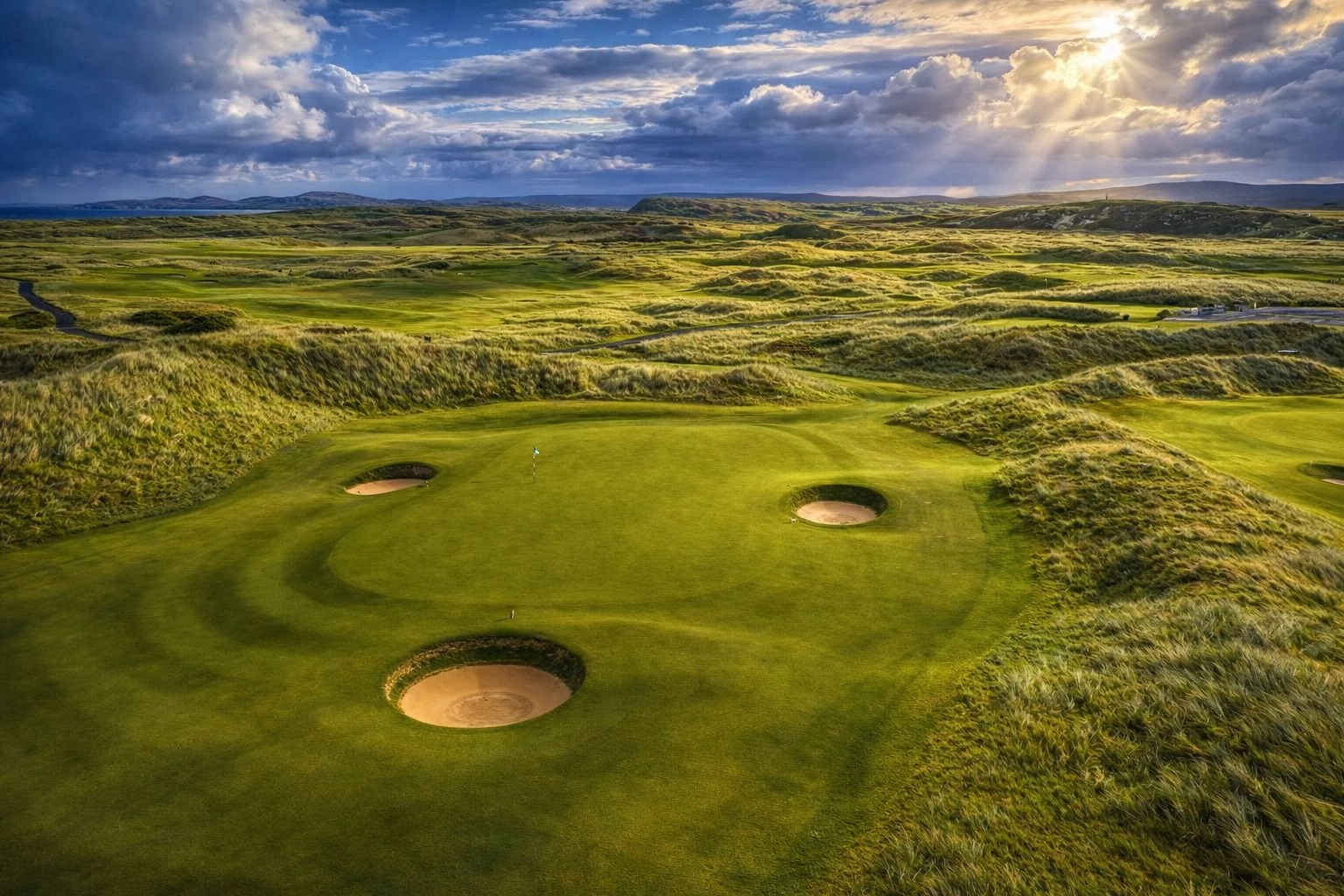
Ballyliffin sits on the Inishowen Peninsula, past Derry and beyond the point where most Irish golf itineraries stop, and that distance is the first thing to understand about it. The club's own history records that Glashedy Links was built on land the club already owned, shaped by the architects Pat Ruddy and Tom Craddock, with construction beginning in May 1993 and the course opening on 3 August 1995. It is a par 72. The club's own hole-by-hole course page gives yardages for all eighteen holes that add up to 7,486 yards, a long card by any standard, laid through dunes that rank among the largest in Ireland. The rock the course and the course's name are named for, Glashedy, sits in the sea off Pollan Bay and comes into view repeatedly on the back nine. We send golfers this far north for one reason. Glashedy is not a warm-up act beside its older sibling, the Old Links. It is the more dramatic of the two, and for anyone building a serious Irish golf trip it belongs on the list, not as a detour but as a destination.
Getting To The Far North Of Donegal
Ballyliffin is not close to anywhere else on a typical Ireland itinerary, and we tell every group that before they book. The nearest useful airports are City of Derry and Belfast International, both roughly ninety minutes to two hours by road depending on where you cross the border, and Dublin is a long day's drive beyond that. There is no shortcut to the Inishowen Peninsula, and the club's own list of nearby reference points places it alongside Portsalon, Rosapenna, Royal Portrush and Portstewart, which tells you the company Ballyliffin expects to be judged against.
The upside of the distance is the payoff. Groups who make the drive north are rewarded with a part of Ireland that still feels undiscovered by comparison with the Dublin or Kerry golf circuits, dune country as big as anything on the island, and a club that has hosted major amateur and professional events without losing the feel of a working members club.
Plan the drive as part of the day, not an obstacle to it. Leave time for the coastal road along Lough Swilly or the Inishowen loop itself, because the approach to Ballyliffin is one of the better drives in Irish golf and rushing it defeats part of the purpose of coming this far.
The Card, And What A Par 72 At 7,486 Yards Means
The club's own course page lists all eighteen holes of Glashedy with their par and yardage, and the figures sum to a par 72 playing 7,486 yards. That is a serious number, well beyond what most visiting golfers will want to play from the back markers on a breezy Donegal afternoon, and the club's hire and booking pages do not specify which tee that total belongs to, so treat it as the course's longest published measurement rather than the one you will actually play.
The hole-by-hole figures published on the course page include four par fives, most of them well over 550 yards, and a mix of long and mid-length par fours that will ask for a mid iron into most greens even when you are not fighting the wind. There are also a pair of shorter par threes in the 170 to 200 yard range that test accuracy rather than raw length.
Ask in the pro shop which tees the course is playing on the day and take the set that lets you reach the fairway without a heroic carry over the dunes. Glashedy rewards position off the tee far more than it rewards distance, and a ball found in play beats a longer one lost in marram grass every time.
The Dunes, And How Glashedy Differs From The Old Links
Where the Old Links plays over older, gentler duneland that the club has worked for decades, Glashedy was built from the start as a modern championship test, routed by Pat Ruddy and Tom Craddock through the largest dunes on the property. The club describes the course as shaped by towering dunes and sweeping coastal terrain, and that description holds up hole by hole. Fairways run between high sandhills rather than simply alongside them, and several tee shots are played from elevated boxes down into valleys you cannot fully see until you are on them.
Because the dunes here are bigger and more sculpted than on many Irish links, blind and semi-blind shots are part of the test. Trust the line the course gives you from the tee markers and the yardage book rather than the eye, and do not be surprised when a well struck shot disappears from view before it lands.
Glashedy Rock itself becomes a repeated presence on the back nine, visible from several tees and greens out across Pollan Bay. It is the kind of view that a visiting golfer remembers long after the scorecard is forgotten, and it is also a useful landmark for reading the wind, since the rock sits exposed to the full force of whatever is coming off the Atlantic.
The Wind Off Pollan Bay
Ballyliffin sits at the very top of Ireland, more exposed to Atlantic weather than almost any course further south, and the wind is the dominant factor in how Glashedy plays on any given day. A calm morning here is a genuine gift rather than the norm, and the course's defenses, generous in width but unforgiving in the rough, are built around the assumption that the wind will do most of the work.
Our rule at Glashedy is the same one we give for every big dunes course on this coast. Keep the ball low and under the wind whenever you can, favor a running shot into the longer par fours, and resist the instinct to force a high approach that the wind will simply carry off line.
Pack for genuine Atlantic weather even in July. A waterproof layer, a warm layer, and a spare glove are not optional this far north, and the club's own hole-by-hole guide notes conditions can shift through a round. We have played Glashedy in sun and in driving rain in the same afternoon, and the golfers who enjoyed both halves were the ones who came prepared for the second.
Reading The Greens And The Short Game
Glashedy's greens sit naturally within the dune contours rather than being built up above them, and the slope of the land around a green usually tells you more about the putt than the surface of the green itself. Before you read a line, look at the hillside it sits against.
Firm, wind-dried turf is typical on this coast for much of the playing season, which means the ball runs further than an American golfer expects both on the green and around it. A chip that would check up at home will release several extra feet here, so favor the lower, running shot around the greens rather than a full pitch whenever the lie allows it.
If a caddie is available, request one. The club notes caddies must be booked in advance and are subject to availability, and on a course this large and this new to most visitors, local knowledge of the blind approaches and the greens is worth more here than on a more familiar links.
Fees, Hire And Caddies For 2026
The club's published 2026 standard visitor rate for Glashedy Links is 330 euro for eighteen holes, with the Old Links priced at 300 euro and a two round special of 550 euro for 36 holes on the same day, covering both courses. These are the figures printed on the club's own fees page for 2026. We do not know what the club will charge in a different season or in 2027, and you should confirm the current rate when you book rather than assume these numbers hold indefinitely.
Hire charges are also published. A pull trolley is 5 euro per round, an electric trolley 25 euro, and a golf cart or buggy 50 euro, all per round, with the club noting that carts cancelled on the day of play are charged in full and must be kept on the fairways at all times. A senior caddie is 80 euro plus gratuity and a forecaddie 120 euro plus gratuity, also to be booked in advance.
The club's terms state that full payment of green fees is required at the time of booking to secure a tee time, and sets out a sliding cancellation refund, 75 per cent at least 30 days out, 50 per cent between 8 and 30 days, and no refund inside 7 days or for a missed booking. Build that into your planning rather than discovering it after a change of plans.
Who Glashedy Suits, And Who It Does Not
Glashedy suits the golfer who wants a genuinely modern, large-scale links experience, built with championship play in mind, and who does not mind a long drive to get there. It suits groups travelling with a driver or a rental car who are building a full Donegal or northwest leg into their trip rather than a single day excursion from Dublin or Belfast.
It is less suited to a golfer looking for a short, sheltered round, or to a group trying to fit Ballyliffin into a single packed day alongside courses two or three hours away. The travel cost of reaching Inishowen only pays off if you give the destination its due, which in practice means at least one night in the area and, ideally, a round on both the Old Links and Glashedy while you are there.
How To Fold It Into A Trip
Ballyliffin pairs naturally with a northwest Donegal and Causeway Coast itinerary that also takes in Royal Portrush and Portstewart to the east, or with a run further south along the Wild Atlantic Way that includes Narin & Portnoo. The club's own site does not offer on site accommodation, so plan to stay in the surrounding Inishowen area and treat the golf as the anchor of a wider coastal stop rather than a single afternoon.
We would give Ballyliffin two full days where possible, one for each course, with the Inishowen 100 driving loop or Malin Head on the morning you are not playing. The north of Donegal rewards the golfer who treats the detour as the point of the trip rather than a box to check on the way to somewhere else.
Questions we get asked
- What is the par at Ballyliffin's Glashedy Links?
- Glashedy Links is a par 72. The club's own hole-by-hole course page lists yardages for all eighteen holes totaling 7,486 yards, though it does not specify which tee that figure represents.
- Who designed Glashedy Links?
- The course was designed by Pat Ruddy and Tom Craddock, following discussions with the club's development committee in the early 1990s. Construction began in May 1993 and the course opened on 3 August 1995, according to the club's own history.
- How much does it cost to play Glashedy Links in 2026?
- The club's published 2026 standard visitor rate is 330 euro for eighteen holes on Glashedy Links, 300 euro for the Old Links, and 550 euro for a two round special covering 36 holes on both courses in a single day.
- Is Ballyliffin far from Dublin or Belfast?
- Yes. Ballyliffin sits on the Inishowen Peninsula in Donegal, closer to City of Derry and Belfast International airports, both roughly ninety minutes to two hours away by road, than to Dublin.
- Can you hire a caddie or a buggy at Ballyliffin?
- Yes. The club publishes a senior caddie rate of 80 euro plus gratuity and a forecaddie rate of 120 euro plus gratuity, and a golf cart or buggy at 50 euro per round. All must be booked in advance and are subject to availability.
- Should I play the Old Links or Glashedy Links at Ballyliffin?
- We recommend both if your schedule allows it. Glashedy is the larger, more modern, more dramatically duned of the two, while the Old Links plays over gentler, older terrain. The club offers a 36 hole two round special covering both in a single day.
How we checked this
Further reading from the Notebook