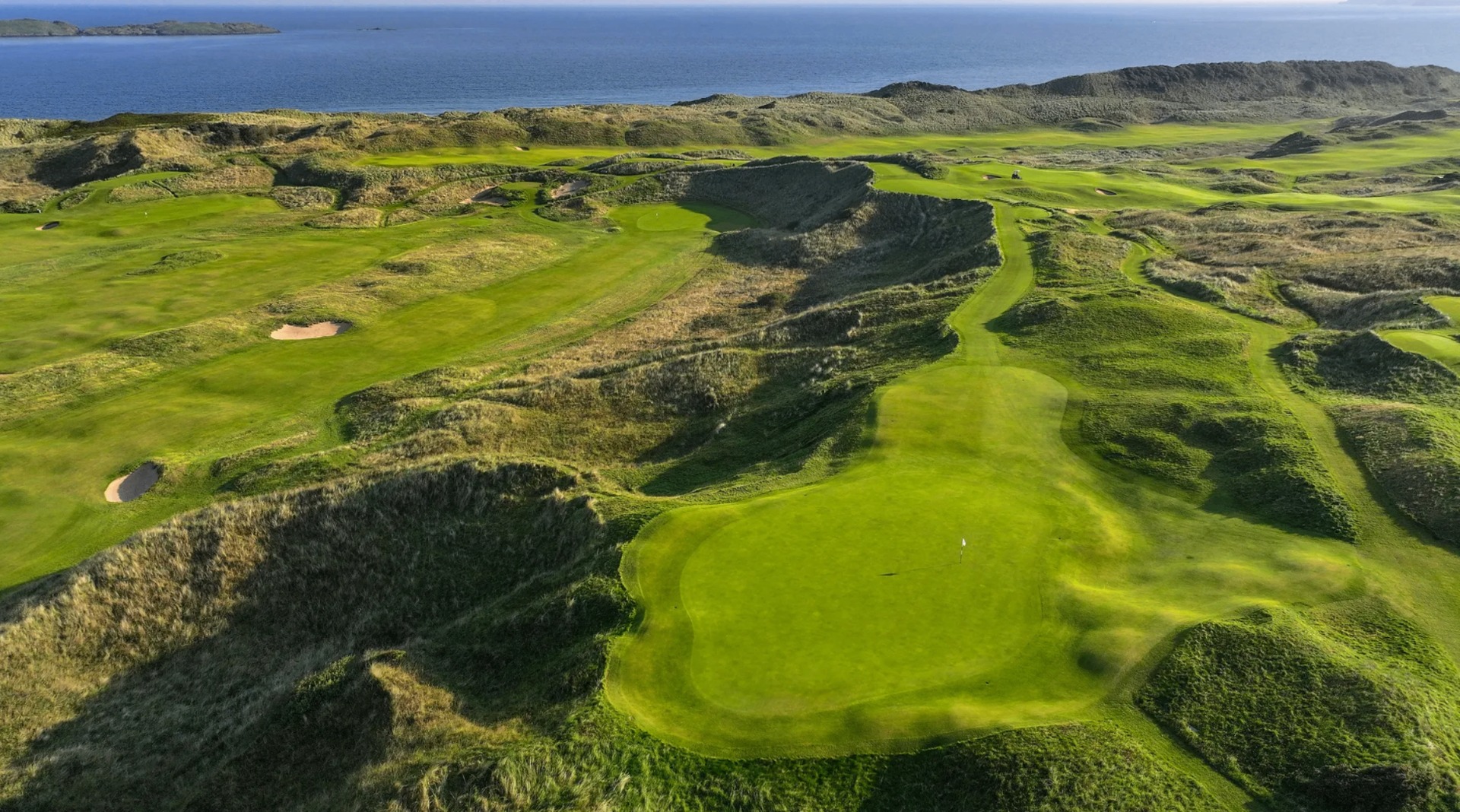
Confirmed and observed handicap policies at Royal County Down, Royal Portrush, Portmarnock, Ballybunion, Lahinch, Waterville, Tralee, and Adare across four summers
A fourball arrives at Royal County Down on a bright Wednesday in June, coffee in hand, the round of the trip on the tee sheet. Three of them have played together for twenty years. The fourth is a brother-in-law who took up the game late and is, by his own honest account, still finding his way. At the pro-shop desk, the starter asks, politely and without ceremony, to see everyone's current handicap. Three cards come out of three wallets. The fourth player looks up, and the small silence that follows is the one this article exists to prevent. It is a conversation that could have been had over email six months earlier, in a Charleston kitchen, with nobody standing on a first tee and nobody's day at risk.
The Conversation Nobody Wants At Check-In
The moment above is not rare. We have watched a version of it happen at almost every serious Irish links, and the reason is not that the clubs are being difficult. It is that American groups typically plan the golf and the hotels and the caddies with great care, and then treat the handicap question as something that will sort itself out on the day. It generally does not. The fix, though, is small. A single email to the pro shop before the deposit is paid, a quick check of each player's current index against the club's published visitor policy, and the problem disappears entirely.
So this piece is not really about certificates or numbers. It is about planning your group properly before you leave home, so that everyone in your fourball has an honest expectation of where they are playing and why. If you get that right, you will not think about handicaps again once you land. If you get it wrong, you will think about very little else on the drive back from Newcastle.
The Handicap Is There To Protect The Experience
It helps to understand what the requirement is actually for. Championship links like Royal County Down, Royal Portrush and Portmarnock ration scarce visitor times on a real course, and a pace of play that lets everyone in front of you and behind you have a good day depends on the fourballs on the course being roughly capable of playing it. A stiff crosswind on the ninth at RCD, with rough that swallows a ball at the ankle, is not a fair test for a genuine beginner, and the round in front and the round behind will feel it inside three holes. The clubs are protecting their guests, not gating them.
There is a safety piece too, at the exposed tees and the blind carries, and a preservation piece around wear on the more delicate holes. In our experience the pro-shop staff at these clubs are unfailingly warm about it. The conversation, when it happens, is practical rather than confrontational. They want your fourball to have the round of the trip. They also know, from long experience, which combinations of players and conditions produce a genuinely miserable five and a half hours. When you read the published limit as an act of hospitality rather than an act of exclusion, the whole question becomes easier to plan around.
How We Build A Mixed-Handicap Golf Trip
Most American groups arriving in Ireland are mixed. A single-digit son-in-law, a father-in-law who used to be single-digit, two friends who are honestly somewhere in the mid-teens, and a fifth or sixth who came along for the trip more than the golf. The mistake is to plan the itinerary as if the group were homogeneous and then discover, on the morning of the round of the trip, that the shape does not fit. The better move is to plan the whole week around the actual spread of ability from the outset.
The way we do it in practice is to alternate the championship days with softer, more forgiving rounds, and to make good use of second courses where they exist. The Annesley at Royal County Down and the Valley at Royal Portrush are honest rounds in their own right, and they give the higher-handicap players in the group somewhere to enjoy the same clubhouse morning without the strain of the main course. Warm-up rounds on the arrival day at a friendlier links help everyone find their swing before the round that matters. And a resort day at Adare or Doonbeg, mid-week, gives the whole group a shared morning where nothing is at stake. The trip that ranks the toughest courses back to back is the trip that ends with someone quietly not enjoying themselves.
What The Clubs Typically Ask For
The documentation question is simpler than the internet suggests. In our experience, an Irish pro shop that wants to see a handicap will accept any current, recognised evidence of your index: a WHS printout, a GHIN screenshot, a signed letter from your home professional, or a photograph of your home-club handicap page dated recently. Bring one of these for every player, keep a printed copy in each wallet, and the check itself, when it happens, takes about twenty seconds. You will not be asked to explain the calculation. The starter will glance, note the number, and hand back the scorecard.
The one habit worth forming is redundancy. Cellular data can be thin at exactly the wrong moment, and screenshots that live inside an app can be surprisingly awkward to surface when the wind is blowing horizontally at the pro-shop door. A folded sheet of paper for each player is the format that has never once let us down. If your home club will write a short letter on letterhead, take it. It reads as a courtesy to the Irish pro shop and it opens a small door of goodwill that occasionally matters at the edges.
Where The Rules Typically Bite, And Where They Do Not
Broadly, and always subject to the club's own current visitor guidance, the strict end of the spectrum in Ireland is Royal County Down, Royal Portrush and Portmarnock. These are the clubs whose published policies you should treat as real numbers, and whose limits you should confirm against every player's current index before you pay a deposit. Adare Manor and Portmarnock in particular publish visitor guidance that is worth reading in full rather than skimming. Always check the latest policy on the club's own website, since limits and enforcement occasionally move season to season.
The Southwest and West-coast links, by which we mean Ballybunion, Lahinch, Waterville and Tralee, tend in our experience to publish similar limits and to sit softer in practice at the first tee. The resort courses, Adare Manor, Trump International Doonbeg and Slieve Donard among them, generally treat the round as guest play and lean on dress code and pace of play as the main expectations. None of this is a licence to book beyond your group's real level. A genuine novice will not enjoy Ballybunion Old in a stiff wind whether or not the pro shop asks the question. The right question is not whether you will be turned away. It is whether the round will actually be a good day for your group.
Planning Around It Before You Pay The Deposit
The single most useful habit we have is the six-months-out check. As soon as the tee-times are provisionally held, we list every player in the group beside their current index, we open each club's published visitor policy in a browser tab, and we ask a simple question: is anyone in the group meaningfully close to the published limit at any of the clubs on this itinerary? If the answer is yes, we write to the club. A short, polite email to the pro shop, well before deposits are paid, resolves almost every situation we have encountered. Clubs generally reply quickly and generously, and the answer, once it exists, lets you plan around it rather than hope past it.
The other habit is to build a small amount of flexibility into the itinerary itself. Booking a second-course option alongside a championship morning at RCD or Portrush, rather than committing the whole fourball to the harder round, costs nothing extra and gives the group a graceful way to split for four hours and reunite for lunch. Booking the softer day first, so that everyone finds their swing before the round that matters, is worth more than most groups realise. And if a player in your group is a genuine beginner, six months of posted scores at a US club before the trip will produce an honest index that opens more doors than a hopeful conversation on the tee.
What A Well-Planned Group Feels Like
The best Irish golf trips we have organised have almost nothing to do with the handicap question by the time the group is on the ground. Everyone has an honest sense of which courses they are playing and which they are watching. Nobody is trying to prove a number they do not have. Two of the group might peel off for the Valley Links while the other two play Dunluce, and the four of them meet in the bar afterwards with two rounds worth of stories rather than one round of tension. The trip stops being about who is playing where and becomes what it was always meant to be, which is a week of golf together in a country that repays that kind of care.
So the practical work is small. Confirm each club's current visitor policy on its own website. Check every player's index against it at the point you book, not at the point you fly. Write one email if anyone is close to the line. Build a second-course option into the strictest days. Bring a printed card for every player and a home-professional letter if you can. Do those five things a few months before departure, and you will spend no mental energy on this at all once you land. The mornings will be about the wind off the Atlantic and the caddie's read on the fourteenth green, which is where the memory of an Irish golf trip actually lives.
Now that you know how it works
Where your handicap will and will not be asked for
The certificate question is settled. What matters next is which courses to put in the diary, and in what order to book them.
Adare Manor
County Limerick, The Golden Vale
No handicap requirement, the most polished experience in the country, and the easiest first round of a trip.
Portmarnock
Sutton Peninsula, County Dublin
Twenty five minutes from Dublin airport, which makes it the arrival day round almost nobody books.
Royal County Down
Newcastle, County Down
Bring a certificate and book the ballot window early. This is the one that fills first.
We have played these courses and we live here. There is no fee for the planning and nothing to sign.
Questions we get asked
- Do I need a handicap certificate to play in Ireland?
- At the championship links you typically do. Royal County Down, Royal Portrush Dunluce and Portmarnock generally ask to see a current handicap. Most other clubs are softer in practice. Always confirm the latest visitor policy on the club's own website before booking.
- What handicap limit should I plan around?
- Published limits vary by club and season, and the strict clubs tend to sit in a broadly similar range for men and women. Rather than treating any number as fixed, check each club's current visitor page and email the pro shop if any player in your group is close to the line.
- What if a player in our group does not have a handicap?
- Route that player to a resort round or a second course on the day the group plays the strictest club. Most parkland courses and resort layouts do not require a handicap. A letter from a home professional confirming a working handicap is often accepted where a formal index does not exist.
- How should we show our handicap at the club?
- A printed card from your home club or a screenshot from your national handicap system is generally accepted. Bring a printed copy for every player, since cellular data can be thin at pro-shop doors. The check itself is usually a brief formality.
- How strict is the enforcement in practice?
- It varies by club. Royal County Down, Royal Portrush and Portmarnock tend to check. Softer clubs often do not re-check at the tee. In every case, our advice is to confirm current policy before booking rather than testing it on the morning of the round.
How we checked this
Further reading from the Notebook
- How to play Royal County Down
- How to play Royal Portrush
- How to book a tee time at Royal Portrush
- What the non-golfer does while you play
- How much to tip a caddie in Ireland
- Renting golf clubs in Ireland
- The dress code at Irish golf clubs
- Shipping your golf clubs to Ireland
- Royal County Down: the collection
- The Ireland Edit Golf Collection