A note from Deborah. Read her editorial perspective
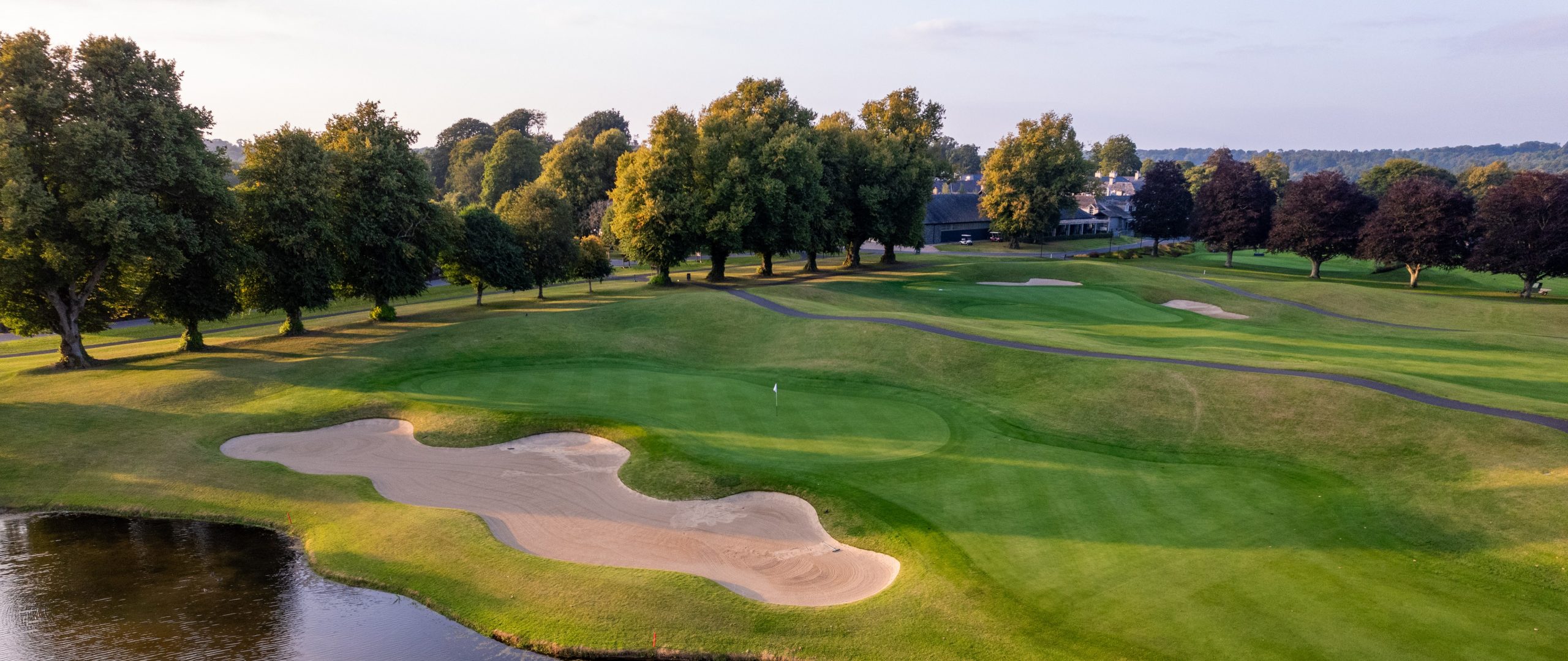
Mount Juliet Estate sits on 500 acres of parkland along the River Nore in County Kilkenny, and the golf course that Jack Nicklaus laid out across it in 1991 is still described by the club in the same terms it used at the start: a par 72 of approximately 7,200 yards, with five constructed lakes affecting six of the holes and more than 80 bunkers worked into the terrain. The club states plainly that the third hole from the championship tee asks for 180 yards of carry over water, that the 11th, 13th and 14th are guarded by bunkers and lakes in equal measure, and that the 16th green sits inside a wall, almost entirely ringed by sand. This is a course built for championship golf, and it has hosted it: the World Golf Championship in 2002 and 2004, the Irish Open in 1993, 1994, 1995, 2021 and 2022, and the OFX Irish Legends in 2025. We send American groups here because it rewards position rather than power, and because the setting, a Georgian estate on a working river, is as much a part of the day as the card. This guide is what we would tell a group before their first round at Mount Juliet.
The Estate And Getting There
Mount Juliet is in Thomastown, County Kilkenny, about ninety minutes from Dublin Airport and fifteen minutes from Kilkenny city. For an American group, that puts it comfortably within a southeast Ireland loop that can include Kilkenny's medieval streets, the Waterford coast, and a run up toward the capital at the end of the trip.
We would not play on the day you land. The course is a full test and the drive from Dublin, while short by Irish standards, still comes after a transatlantic flight. Arrive the evening before, settle into the Manor House or Hunter's Yard, and let the course be the first full day rather than an afterthought squeezed in on arrival.
If your group includes non-golfers, the estate gives them somewhere to be. The 500 acres carry an equestrian centre, falconry, fly fishing, archery and clay shooting, so the day the golfers are on the course is not a day the rest of the party has to spend in a hotel room.
The Card, And What It Tells You
A par 72 at approximately 7,200 yards from the back tees is a long card by any standard, and Nicklaus built it to be played from width rather than muscled through. The club's own description of the design calls it ambitious and mischievous, a fair summary of a course that keeps asking a visiting golfer to make a decision rather than simply hit the ball forward.
We would treat the championship tees the way we treat them everywhere else: as a number for the scorecard, not an instruction. Nicklaus Signature courses are built with multiple tee options precisely because the architecture rewards the player who is hitting a full approach with a club they trust, not the player who is hitting driver and hybrid into every green because the tees were too far back. Ask the golf shop which tees suit your group's length and move forward from habit, not from pride.
The one hole the club names specifically is the third, where the championship tee carries 180 yards over water. That is a useful early warning of the round's shape. Water is not an occasional obstacle at Mount Juliet. It is built into the strategy of a third of the holes, and the sooner your group settles into playing around it rather than through it, the better the round goes.
Five Lakes And The Water That Decides Six Holes
The club states that five lakes have been constructed across the course and that they enhance six of the holes. Enhance is the club's word, and it is accurate in the way that word usually is on a Nicklaus course: the water is rarely in the direct line unless you choose a line that puts it there.
Our approach to a course built this way is simple. Identify, before the round or at the latest from the tee, which side of each water hazard gives you the shorter carry and the better angle, and take that side even when it costs you a few yards. A lost ball in a Kilkenny lake costs more strokes than a conservative tee shot ever will.
The 11th, 13th and 14th are the holes the club singles out as most heavily guarded by both bunkers and water together. Treat that stretch as the heart of the round. If you are playing steadily through the front nine and into the middle of the back, these three holes are where a sensible plan gets tested, and where the discipline to lay up short of trouble rather than carry it pays off most clearly.
Over 80 Bunkers, And How To Play Around Them
Mount Juliet carries more than 80 bunkers, strategically placed according to the club, and on a parkland course of this scale that is a genuinely high number. Expect fairway bunkers positioned to catch the longer, more aggressive drive, and greenside bunkers that protect the putting surfaces from anything but a well-struck approach.
We would rather see a visiting golfer play a club shorter off the tee and have a full shot into the green than take driver, catch a fairway bunker, and have to escape sideways before even starting toward the flag. Parkland bunkers of this density are built to punish length without accuracy, which is exactly the swing most of us bring on holiday.
Around the greens, take your medicine. A bunker shot played safely to the middle of the green beats a bold shot at a tucked flag nine times out of ten. The course has enough built-in difficulty that it does not need help from an unnecessary risk.
The Walled Sixteenth
The club calls the 16th the course's most unusual feature: a walled green almost entirely surrounded by a bunker. It is the kind of hole that photographs well and plays harder than the photograph suggests, because a wall changes the way wind and ball behave around a green in ways an open approach does not.
We would club up rather than down on the approach here. A shot that comes up a fraction short against a wall and bunker combination has nowhere good to go, while a shot that carries slightly long onto the putting surface leaves a manageable two-putt.
Walk this green before you putt if your pace of play allows it. The wall affects more than the tee shot. It can also affect how you read the surface, since a vertical stone face beside a green changes the light and the visual reference points you are used to on an open hole.
Reading The Parkland Greens
This is a parkland course rather than a links, and the greens behave accordingly. Expect them to hold an approach shot more readily than a links green would, and expect borrow that is read from the slope of the green itself more than from surrounding dunes or terrain, since there are none here.
Nicklaus-designed greens tend to have more internal movement than their size suggests from the fairway. Take an extra moment from the side of the green, not just behind the ball, before you commit to a read. A putt that looks straight from behind the hole can reveal a clear right-to-left tilt from the side.
Because water and bunkers protect so many of these greens, the short game around them rewards a controlled pitch more than an aggressive flop. Land the ball on the putting surface and let it release toward the hole rather than trying to spin it dead, especially on the firmer surfaces of a dry Irish summer.
Pace, Caddies And The Academy
Mount Juliet is a buggy-friendly course, and the club states that buggies are available from the golf shop if booked in advance, fitted with GPS systems that give live pin positions and distances during the round. For a long parkland course of this scale, we would book one, particularly for a group travelling after a long flight.
The Golf Academy on site uses TrackMan and TopTracer technology with PGA professional coaching available, which is worth an hour on the eve of your round if your group has not played in a while. A warm-up session with real feedback on ball flight is a better use of a spare afternoon than another lap of the hotel grounds.
The club requires a collared shirt and does not permit sports jerseys, denim, tracksuits, sleeveless tops or hoodies on the course, and shorts must be tailored rather than casual. Pack accordingly. Visitors who arrive out of dress code are asked to change or may be asked to leave the course.
Who Mount Juliet Suits, And How To Fold It Into A Trip
Mount Juliet suits the golfer who wants a championship-calibre parkland test without the travel required to reach the west coast links, and it suits a mixed group where some members want a serious round and others want falconry, fishing or the spa in the same afternoon. The estate is built for exactly that split.
It is less suited to a golfer who has crossed the Atlantic specifically for Irish links golf and wants dunes and sea wind. That is a different course entirely, and we would not try to make Mount Juliet stand in for it. Treat the two as complementary rather than competing parts of an Ireland golf trip.
A sensible southeast Ireland plan uses Mount Juliet as an anchor for two or three nights, with a morning round, an afternoon at the estate's other activities or in Kilkenny city, and a drive toward Dublin or down to the Waterford coast to close the trip. The course does not need to be the only reason you come, but it is a strong enough reason on its own.
Questions we get asked
- What is the par and length of Mount Juliet's golf course?
- The estate describes the course as par 72 at approximately 7,200 yards from the back tees. The club's own pages give slightly different figures across different sections of the site, 7,200 yards and 7,264 yards, so treat the length as approximate rather than exact.
- Who designed the golf course at Mount Juliet?
- Jack Nicklaus designed the course as one of his Signature Design projects. It opened in 1991.
- How much water is in play at Mount Juliet?
- The club states that five lakes have been constructed and that they affect six of the eighteen holes, including a 180-yard carry over water on the third hole from the championship tee.
- What is the walled green at Mount Juliet?
- The 16th hole has a green that sits inside a wall and is almost entirely surrounded by a bunker, which the club describes as the course's most unusual feature.
- What tournaments has Mount Juliet hosted?
- The estate has hosted the World Golf Championship in 2002 and 2004, the Irish Seniors Open in 1999, the Irish Open in 1993, 1994, 1995, 2021 and 2022, and the 2025 OFX Irish Legends.
- Can I rent a buggy or clubs at Mount Juliet?
- Yes. The golf shop publishes a buggy fee of 60 euro if booked in advance, and club hire at 90 euro, which includes two sleeves of balls.
How we checked this
Further reading from the Notebook