A note from Deborah. Read her editorial perspective
Enniscrone is the course that regularly surprises Americans who came west for County Sligo and found, half an hour down the coast, a links that some good judges rate higher. The club's own history lists the founding in 1918, an expansion to eighteen holes in 1930, and then the event that made the modern course: a major redesign in 1970 overseen by Eddie Hackett, the architect most responsible for the shape of Irish golf on this coast. The Dunes course the club publishes today plays to par 73 and 6,833 yards, routed through dune country so tall in places that you lose the clubhouse behind a ridge on the par five seventh, a hole the card itself names Hacketts. Golf Digest Ireland has ranked it inside the national top fifteen twice in the last two decades. None of that tells you what it is like to stand on the first tee with a Sligo wind coming off Killala Bay, so this guide does.
Getting There And Arriving
Enniscrone sits on the south side of Killala Bay, across the water from County Mayo and about forty minutes from County Sligo town. Most American groups reach it either by flying into Ireland West Airport Knock, which sits closer to Enniscrone than any other airport in the country, or by driving over from a Sligo or Donegal base after flying into Dublin or Shannon.
We would not play Enniscrone on the day you land regardless of which airport you use. The drive from Knock is short, but the course rewards a rested swing more than most, and a jet lagged group tends to leave their best shots on the practice ground rather than on the course. Arrive the evening before, walk the beach at Enniscrone town, and tee off the following morning.
If your trip is built around County Sligo at Rosses Point, Enniscrone is the natural companion round, close enough for a morning tee time without an early start. Tell the pro shop your group size and preferred tee time windows when you call, and ask about Scurmore, the club's nine-hole second course, if anyone in your party wants a shorter outing while the main group plays the Dunes.
The Card, And What It Tells You
Enniscrone's own scorecard lists the Dunes course at par 73 and 6,833 yards, with ten par fours, four par threes and four par fives worked into the eighteen. That is a long card for a links, and the length is not evenly spread. The front nine runs out to 3,575 yards and closes with two par fives inside the first seven holes, Nephin at the fourth and Hacketts at the seventh, so a group that wants to post a score should look for it early.
The back nine is shorter on paper but trickier in practice, with a run of par fours in the twelve hundreds, Cnoc na gCorp and The Burrows, that play through the tightest part of the dune field before the course opens out again at the Valley of Diamonds, a 537 yard par five fourteenth that is the longest hole on the back nine.
Ask the shop which tees suit your group before you start. A card this long into any wind off the bay punishes the golfer who insists on the tips. Step forward a set from your habit at home and you will see more of the course and less of the rough that lines it.
The Dunes, And Why They Are The Course
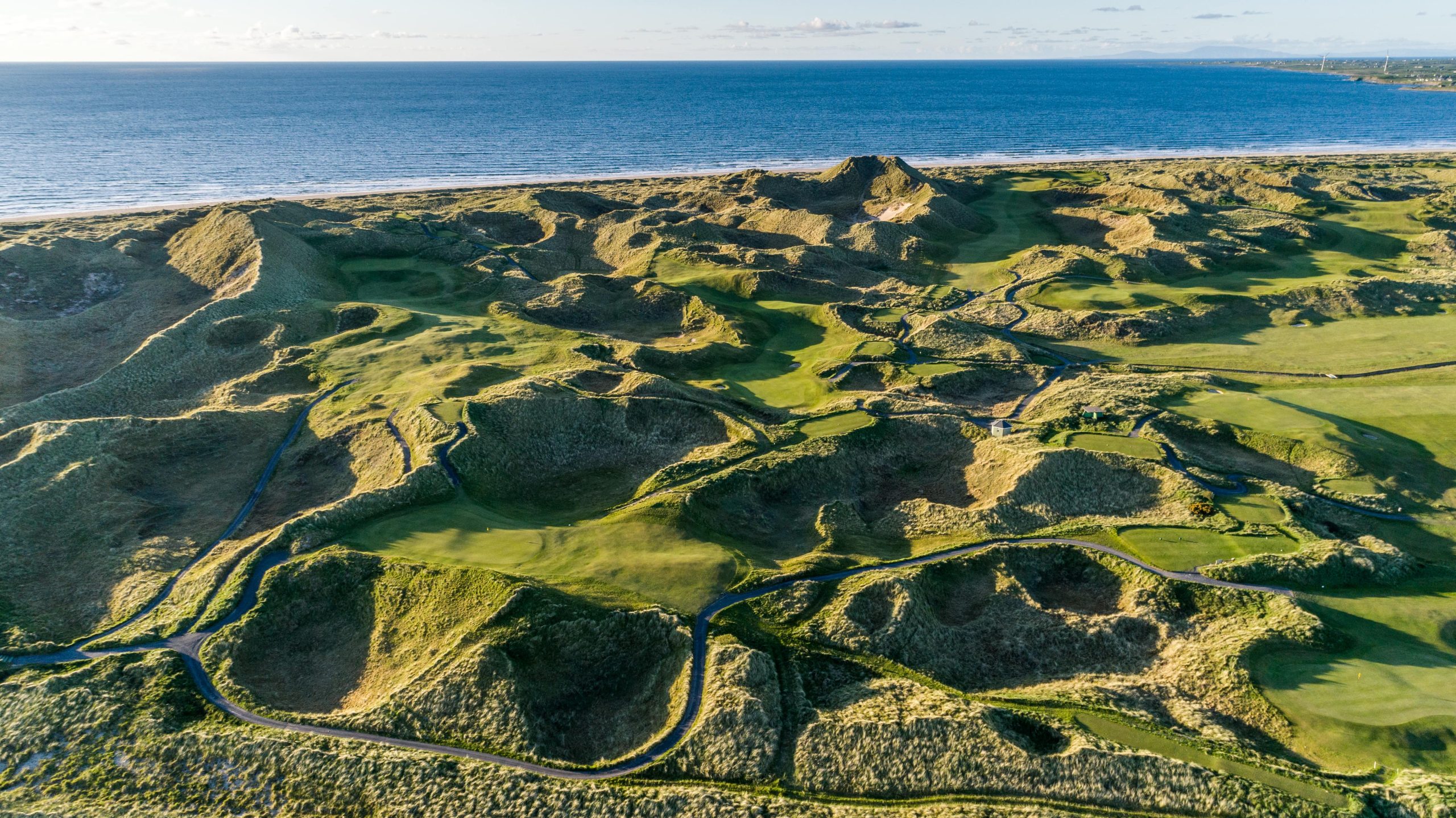
Enniscrone's dunes are taller and more enclosing than at many of the famous links further south, and the 1970 Eddie Hackett redesign is what turned that raw landform into a golf course rather than a beach with grass on it. Hackett's method, here as at Carne and Connemara, was to find the golf inside the land rather than force a plan onto it, and the result is a run of holes where the fairway disappears between ridges and reappears at a green tucked into a hollow.
The third, Devlin, and the eighth, named Scurmore after the club's other course, are both short par threes that use the dunes as a backstop rather than a hazard, which means a shot that finishes pin high and short is rarely punished the way it would be on a flatter course. We tell first time visitors to aim for the centre of these greens and let the bank feed the ball toward the hole.
The dune country tightens most on the back nine, and that is deliberate. Hackett kept the longest carries and the widest fairways for the front nine, where a group is still finding its rhythm, and saved the squeeze for the inward half, when concentration should be at its sharpest anyway. Play the back nine like a different, more demanding course, because it is.
The Wind Off Killala Bay
Enniscrone faces Killala Bay rather than the open Atlantic, which changes the character of the wind compared with a course like Carne or County Sligo. It still blows hard, but it tends to hold a more consistent direction across a round rather than swinging as sharply as it does on a headland course, which rewards a group willing to commit to a plan for the day rather than reacting hole by hole.
The dunes themselves also funnel the wind in places, so a hole that feels calm on the tee can turn gusty forty yards in, where the land narrows. Watch the grass on the ridge above the green, not just the flag, before you commit to a club on the approach.
Keep the ball under the wind whenever the hole allows it. On firm Sligo turf a low running shot holds its line far better than a high one, and the greens here, tucked into hollows more often than perched on plateaus, are built to receive a ball that arrives on the ground.
Reading The Greens
Because so many greens at Enniscrone sit in natural hollows rather than built-up pads, the slope of the dune behind the green usually tells you more about the break than the green surface itself. Stand behind the ball, look up at the bank, and read the putt from there before you look down.
A caddie, if you book one, will know these greens from decades of play and is worth the fee on a course this intricate. If you go without, trust pace over precision. On firm turf a putt that dies at the hole from four feet short is a better miss than one that races three feet past.
Short game around these greens rewards the same ground game philosophy as the approach shots. A bump and run with a mid iron, landing well short and letting the slope carry it onto the putting surface, beats a lofted pitch more often than American instincts expect.
Lessons, Caddies And Pace
The club notes that courteous play keeps a round inside four and a half hours, which is the benchmark to plan around. Caddies are members familiar with the course and can be requested when you book your tee time online or by calling the club directly, and we recommend requesting one for a first visit, since the blind shots through the dunes are easier played with local knowledge than guessed at from a yardage book.
Enniscrone also offers a driving range, chipping green and putting green at its practice facilities, and a session there the afternoon before your round is worth the time, particularly to groove the low punch shot you will play more often than any other on the Dunes course.
Check in at the golf shop thirty minutes before your tee time, as the club asks. On a course this layered with blind corners, a few minutes spent looking at the hole maps before you start saves shots later.
Who Enniscrone Suits, And Who It Does Not
Enniscrone suits the golfer who wants the full dune golf experience, the kind that makes you forget you can see the clubhouse, without the long drive to Carne or Connemara further up the coast. It suits a mixed ability group well, because the forward tees shorten the long card considerably while leaving the character of the holes intact, and it suits anyone who wants a serious test alongside County Sligo rather than a gentler alternative to it.
It is less suited to a golfer looking for a quick nine or an easy warm-up round. The Dunes course is long and the terrain is demanding underfoot in places, so a group pressed for time or travelling with anyone who tires on hilly ground might prefer the shorter Scurmore course or a half day elsewhere on the coast.
How To Fold It Into A Trip
Enniscrone pairs naturally with County Sligo at Rosses Point, forty minutes north, and the two make one of the strongest back to back links days in the country. A sensible Sligo week gives each course its own morning, with the afternoon between them given to Streedagh Beach or the climb up Knocknarea.
We would not play both courses in a single day. Each deserves the full attention a 6,833 yard card and a set of blind dune shots demand, and a tired group on the second eighteen rarely does either course justice. Two mornings, with a slow afternoon between them, is the rhythm we build every Sligo golf trip around.
Questions we get asked
- What is the par and length of Enniscrone's Dunes course?
- The club publishes the Dunes course at par 73, playing 6,833 yards in total across the eighteen holes, with ten par fours, four par threes and four par fives.
- When was Enniscrone Golf Club founded?
- The club was founded in 1918 and extended from nine to eighteen holes in 1930, according to the club's published history.
- Who designed the Dunes course at Enniscrone?
- The club's history credits a major redesign in 1970 to Eddie Hackett, the architect behind the modern shape of the course through the dune field.
- How long does a round at Enniscrone take?
- The club asks golfers to play courteously to keep a round inside four and a half hours.
- Is Enniscrone close to County Sligo golf club?
- Yes. Enniscrone is roughly forty minutes from County Sligo at Rosses Point, and the two courses pair naturally on consecutive mornings.
- Does Enniscrone have a second course?
- Yes. Scurmore is a nine-hole course at the club offering a shorter round with views over the Atlantic and Killala Bay.
How we checked this
Further reading from the Notebook
- Enniscrone green fees and booking
- How to play Ballyliffin
- How to play Narin & Portnoo
- How to play St Patrick's Links
- Plan an Ireland golf trip
- How to play County Sligo
- Booking a tee time at County Sligo
- How to play Carne's Wild Atlantic Dunes
- The real dress code at Irish golf clubs
- Caddie, buggy, or trolley on an Irish links