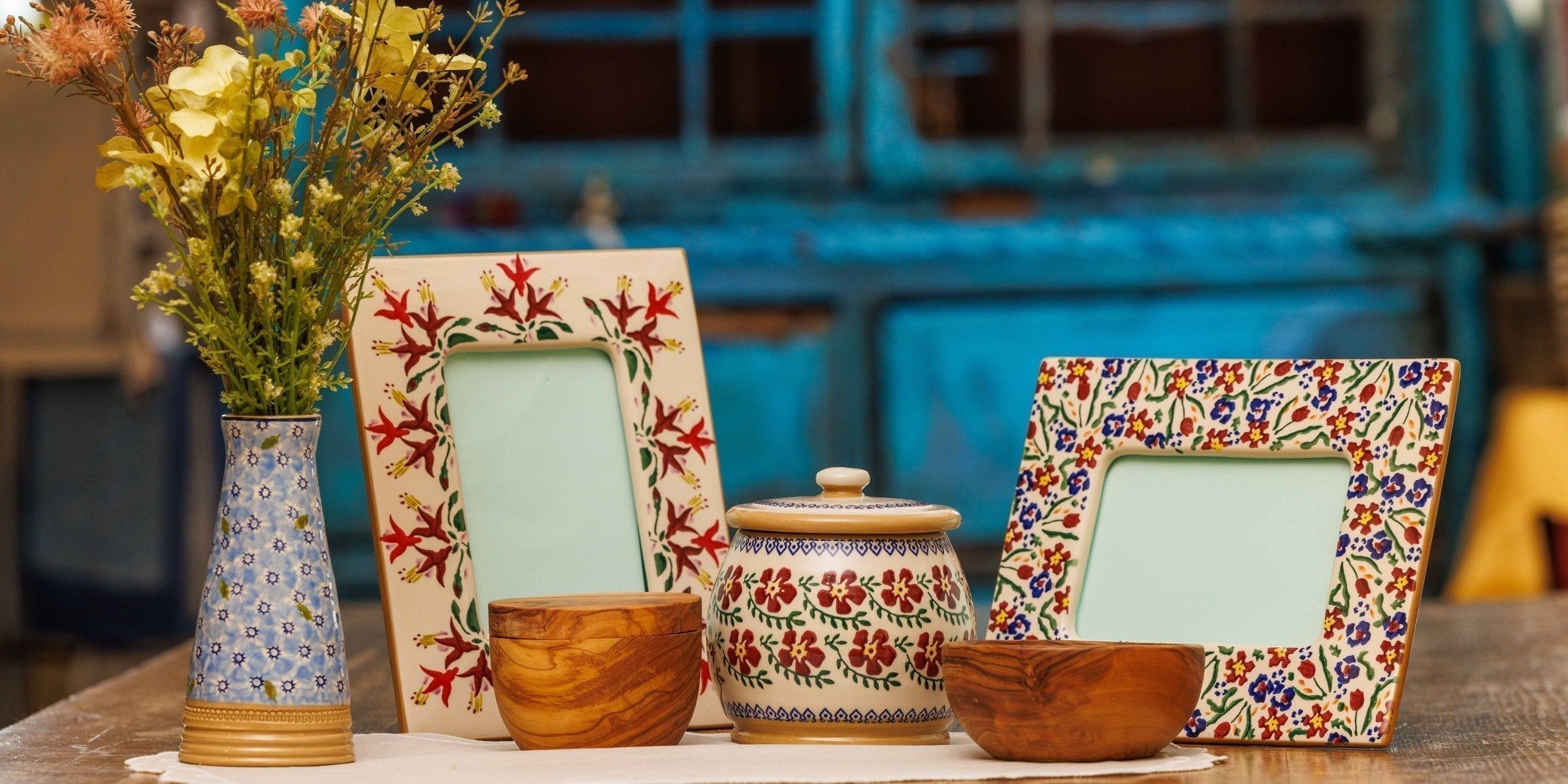
Kilkenny became Ireland's craft county by design, not accident. In the 1960s the state set up the Kilkenny Design Workshops and invited makers from across Europe to settle here, and the county never quite let them leave. Fifty years on, the workshops that made its reputation are still working, and you can stand at the bench in all three.
Start in Bennettsbridge, ten minutes south of the city, where Nicholas Mosse has been making pottery since 1976. Mosse, the son of a milling family, studied ceramics in London and Japan and came home to found his workshop in an abandoned cow shed; later he and his wife Susan bought the old family mill on the River Nore and restored its hydroelectric power to fire the kilns. The mill burned to the ground in 1985 and they built it back. Every piece is still made by hand in a twenty step process, the patterns applied with cut sponges in a technique that dates to the eighteenth century, and Susan, a botanical artist, draws every design from the hedgerows outside.
In Stoneyford, another ten minutes on, Jerpoint Glass has been blowing glass since December 1979. Keith Leadbetter trained at the Orrefors Glass School in Sweden before coming home, and Kathleen, a self-taught artist, created the coloured palette the studio is known for. They started in a converted Dutch barn at their home, and their four children grew into the business; their son Rory has been master glassblower for two decades. You can watch the glass being blown from the viewing area, and the tools have not changed in two thousand years.
The third workshop is in the city itself. Rudolf Heltzel, a goldsmith from Berlin, was invited to Ireland in 1966 to set up and lead the gold and silver studios at the Kilkenny Design Workshops, and in 1968 he opened his own atelier. His sculptural pendants in rock crystal and tourmaline have been exhibited at Dublin Castle and sold through Neiman Marcus, and the gallery at 10 Patrick Street, where his son Christopher now works beside him, is open to anyone who walks in. This is high jewellery made by hand with techniques older than the street outside.
How to do it: the three workshops make a single generous day. Bennettsbridge first, while the decorators are at their benches, then Stoneyford for the glassblowing, then back to Kilkenny city for Patrick Street and dinner. All three sell what they make, and all three ship. A Mosse dinner service, a Jerpoint jug, a Heltzel pendant: this is the shopping trip that furnishes a house and marks an occasion at the same time.
One practical note. These are working studios with benches to stand at, not museums with ropes. The glassblowing at Jerpoint runs to the production schedule, so ring ahead if watching the furnace is the point of your visit. The Mosse shop and café in the mill are the natural lunch stop. And at Heltzel, an appointment earns you the conversation; walk ins are welcome, but a call ahead turns a browse into an education.