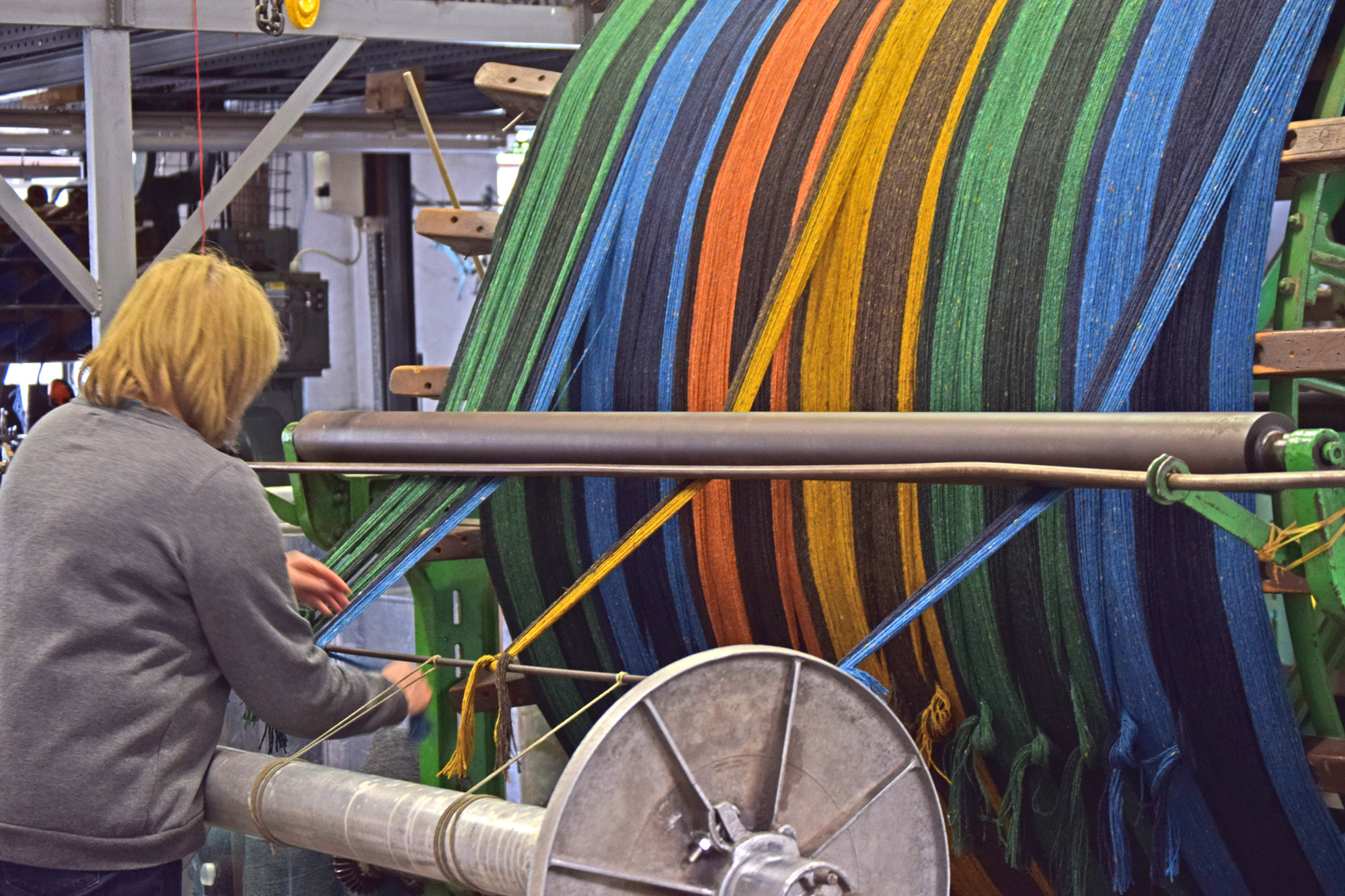
Donegal tweed is not a souvenir category. In Ardara and Kilcar it is still a working trade, and the looms you can stand beside are the ones the cloth on the rail came off that morning. The craft nearly went under in the 1960s, when machine weaving arrived and hand weaving collapsed across the county. What survives today survives because a handful of families decided it would.
Start in Kilcar, a small village on the road to Slieve League. Studio Donegal has been hand-weaving here since 1979, when Kevin Donaghy took over a near-derelict mill to keep the craft alive; his son Tristan and Tristan's wife Anne run it now. Everything bearing the label is hand woven and made in the building, much of it from yarn spun by their neighbours at Donegal Yarns. Visitors are welcome to take an informal tour of the works, and upstairs the weavers work at wooden drop-box looms, each one adjusted to its weaver's body. Ask to see the fabric storeroom halfway up the stairs, where rolls of tweed wait to become jackets, throws and caps.
In Ardara, fifteen minutes back east, Triona is the other half of the story. Denis Mulhern, a fifth-generation hand weaver, founded it in 1984 from the front room of the family home, a decade after the local industry collapsed. The visitor centre on Main Street, open since 1992, runs weaving demonstrations on looms that have been in use for generations, with master weavers and apprentices working side by side. The tweeds here take their colours from the hills and the Atlantic coast outside the door.
The third name is the oldest. Magee began in 1866, when John Magee travelled to markets in Ardara and Carrick buying hand-woven tweed from part-time weavers who were also fishermen and farmers. The mill on the River Eske in Donegal Town followed, and the house tweeds still come from Donegal. It was Magee cloth that designers like Sybil Connolly and Irene Gilbert put in front of the international fashion world in the 1950s and 60s.
How to do it: give the weavers half a day, not an hour. Drive the Glengesh Pass into Ardara in the morning, visit Triona, lunch in town, then continue to Kilcar for Studio Donegal before the road carries you on to Slieve League for the late light. Buy cloth by the metre or a jacket off the rail; both are cut from the same bolts. This is the purchase you will still be wearing in twenty years, and the one with a name and a village attached to it.
One practical note. These are working mills, not attractions with turnstiles. Demonstrations and informal tours run around the work of the day, so ring ahead or check the websites before you set out, especially outside the summer months. What you get in return is the real thing: a weaver who stops the loom because you walked in, and ten minutes of conversation you could not have bought anywhere else.