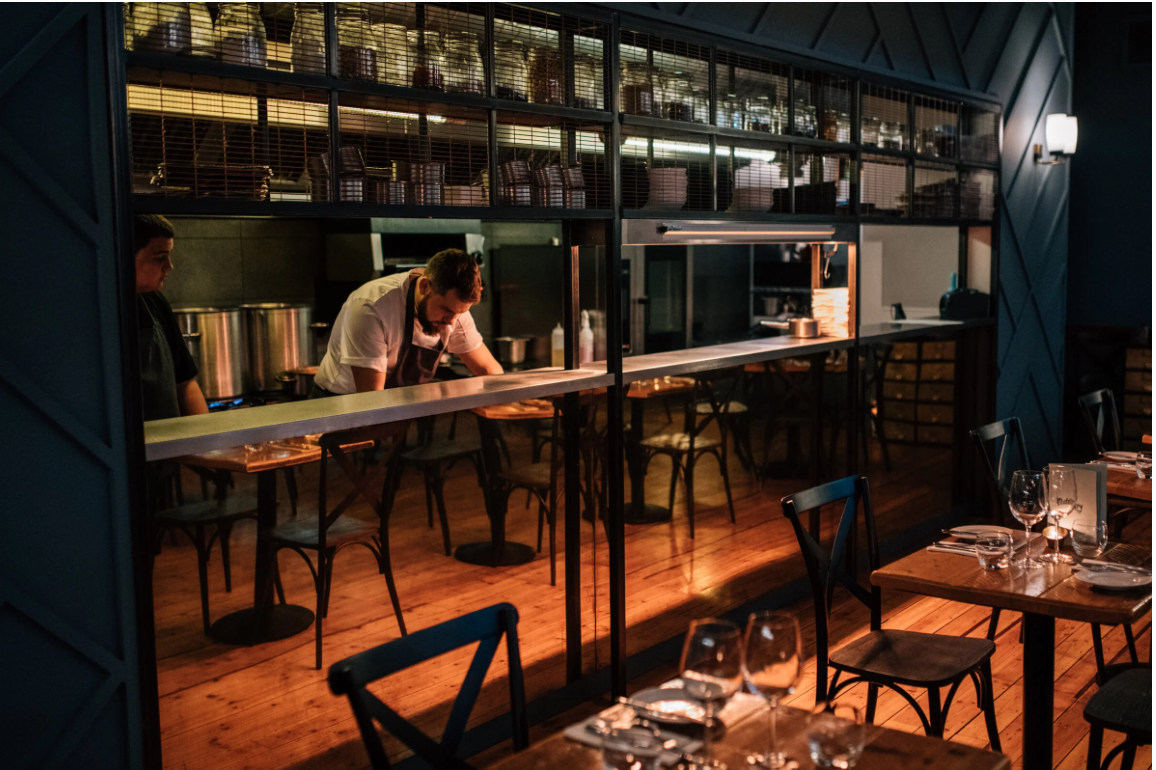
Photo courtesy of The Muddlers Club, Courtesy image
Editorial Review
The Muddlers Club
The Atmosphere
“A Michelin-starred room down an unmarked entry in the Cathedral Quarter, and the most serious cooking within walking distance of a Belfast hotel.”
You find it by looking for a lane rather than a sign. The Muddlers Club sits off Waring Street in a converted warehouse space with an open kitchen at one end, and the room is deliberately plain: concrete, brick, hard surfaces, no cloth on the table. The cooking is the opposite of plain. It is short, precise, and built around Northern Irish produce, and it holds a Michelin star in a city that had none within living memory. The name comes from the 18th-century society that met on this ground, which is a piece of Belfast history the room wears lightly.
The long version
A Michelin star down an unmarked lane off Waring Street, in a city that had none within living memory.
The entrance is the first thing that tells you what kind of restaurant this is. There is no frontage on Waring Street, no menu in a brass frame, no host at a lectern. You turn into Warehouse Lane, which looks like the back of somewhere rather than the front of anything, and the door is there. Inside, the room is concrete and brick with an open kitchen along one end and no cloth on the tables, and the noise is the low industrial hum of a working service.
Belfast spent decades being written about for reasons that had nothing to do with dinner. That the city now holds Michelin stars is a change most American visitors have not caught up with, and this room is the clearest evidence of it. Nothing about the space asks for the credit. The plates do.
“You turn into a lane that looks like the back of somewhere, and find the best dinner in the city.”
What the kitchen is doing
The cooking is short, sharp and built on Northern Irish produce: beef from up the road, fish landed on the north coast, vegetables treated as the centre of a dish rather than the garnish on one. Portions are precise without being mean, and the seasoning is confident in a way that suggests a kitchen that has stopped worrying about being liked.
The menu changes often enough that recommending a dish is pointless. What holds is the register: nothing arrives as a puzzle, everything arrives tasting more of itself than you expected. That is the difference between technique used to impress and technique used to cook.
The room and the neighbourhood
The Cathedral Quarter around it is the most walkable part of Belfast, all entries and cobbles and Victorian warehouses, and the Duke of York is two minutes away if you want a pint before or after. That combination, a serious dinner and a proper bar within a hundred yards, is the argument for staying in this part of the city rather than out at the lough.
The room seats a modest number and the tables are close. It is not a place for a private conversation, and it is not trying to be a hushed dining room. Sit facing the pass if the seat is offered.
Booking it
It books out weeks ahead, particularly at weekends, and the restaurant handles its reservations itself rather than through the usual aggregators. If the evenings are gone, a weekday lunch is the same kitchen at a lower price and a calmer pace.
Belfast is compact enough that you can walk here from most city-centre hotels in ten or twelve minutes, which is worth knowing when a Northern Irish evening decides to rain.
What we would not pretend
It is hard and unlined, so it carries noise. If you want a quiet, cushioned dinner this is not the room, and you will not get a table on short notice at a weekend.
How we would use it
One night of a two-night Belfast stay, booked before we leave home, with a walk through the Cathedral Quarter and a last drink at the Duke of York afterwards.
Public guest perspective
What guests consistently notice
Guests mention inventive Northern Irish cooking, relaxed expertise, and finding such a serious room down an unmarked lane.
The honest caveat
Hard surfaces carry noise, and the tasting format requires time. Weekend availability disappears early.
Guests return for
- Creative local produce
- Friendly, fluent service
- Open-kitchen energy
How to order
Follow the current menu rather than chasing an old signature. A view of the pass adds to the evening.
Before you book
Book several weeks ahead. A weekday service is the calmer fallback when Saturday is gone.
Rooms Worth Requesting
What it actually feels like.
Book weeks out, and take a weekday lunch if the evenings are gone. Ask for a seat facing the pass.
Why we recommend it
A space that justifies the journey.
Belfast eats well now, and this is the room that proves it rather than the room that talks about it. It is also a ten-minute walk from most city-centre hotels.