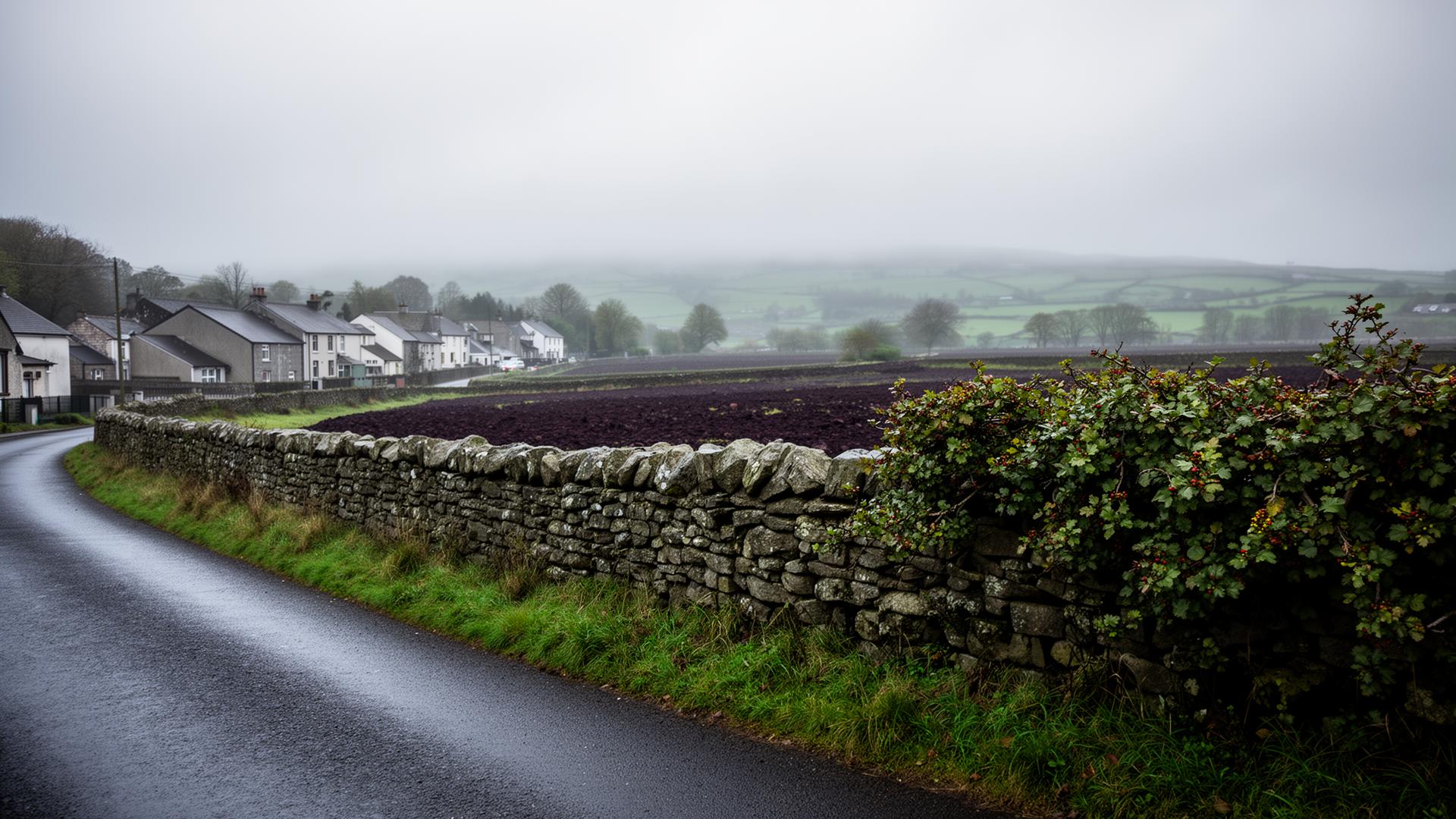
The bog country around Bellaghy, south Derry, in soft northern light

The Bellaghy / Heaney Country Edit

Between the bog and the lough.

A south Derry village, a farm called Mossbawn, and the country a single Nobel laureate made permanent.

Editorial Thesis

A village, a farm, a lough. A whole literature.

Bellaghy is a small village in south County Derry. There are no cliffs, no famous ruins, no coach-tour landmarks. The HomePlace, the museum the village built for its poet, is on the main street between a row of houses and a primary school. The fields outside are flat, wet, agricultural, and quiet. There is no spectacle here. There is only the place itself, and the fact that one of the most important poets in the English language of the twentieth century spent his childhood in it and then spent the rest of his life writing it down.

We treat Heaney Country as our northern literary anchor. Within The Ireland Edit’s itinerary engine, it is the substitution that turns the Literary Dublin 8+ day ladder into a properly two-poet trip: Yeats in the west, Heaney in the north. It is a morning, not an afternoon. It is paired with a Belfast overnight, not a Dublin commute. And it is, in our entire region of coverage, the single place that most rewards the reader who has actually opened the books before they arrive.

Heaney Country is the country of a single sustained act of literary attention. The place is not the spectacle. The attention is.

This guide is the canonical Ireland Edit reference for the region. It is the source page our itinerary engine links back to whenever a Northern Ireland anchor is the right structural answer, and it is meant to function as a definitive editorial guide for any reader who arrives here from search with no itinerary at all.

The Poet and the Place

Heaney was born here. He wrote his way out of here and then back.

Seamus Heaney was born in 1939, the first of nine children, on Mossbawn farm a mile and a half outside Bellaghy. His father, Patrick, was a cattle dealer who spoke as little as possible. His mother, Margaret McCann, came from a family of millworkers in Castledawson. The Heaneys were small Catholic farmers in a mid-Ulster countryside that was equal parts Protestant and Catholic, and the very young Seamus walked daily past Anahorish school, where his early class was taught in both Irish and English by the schoolmaster Master Murphy.

He left for boarding school in Derry city aged twelve, then for Queen’s University Belfast aged eighteen, then for academic and writing posts at Berkeley, Harvard, and Oxford. He moved permanently to Dublin in his thirties. He died in 2013 and is buried, at his own choice, in St. Mary’s churchyard at the southern edge of Bellaghy village, a five-minute walk from the HomePlace. His epitaph, the last line he sent his wife by text message from the operating theatre in his final hour, is ‘noli timere’ — do not be afraid.

The Heaney bibliography divides cleanly into the poems that look at this place and the poems that look at the wider world from this place. The first book, Death of a Naturalist (1966), is more or less a topographical map of Mossbawn farm: the well, the bog, the cow byre, the potato pit. The bog poems of North (1975) extend the same imaginative territory outward into Iron Age Jutland. The late, looser poems of Field Work (1979), Station Island (1984), and Seeing Things (1991) keep coming back. The Nobel Prize, awarded in 1995, cited “works of lyrical beauty and ethical depth, which exalt everyday miracles and the living past.” The living past is mostly here.

What makes Heaney Country different from most literary destinations is that Heaney wrote it deliberately as a place. He was not a poet who happened to come from somewhere. He was a poet whose entire project was the patient nomination of a small piece of ground: Mossbawn, Anahorish, Toome, Lough Beg, Broagh. The village built a museum because the poet had already built a country out of it.
The Literary Landscape

A short geography of the poems.

Heaney Country is a small area, ten miles at most edge to edge. The northern edge is the village of Bellaghy itself, with the HomePlace and St. Mary’s churchyard. A mile-and-a-half east of the village is Mossbawn, the family farm where Seamus and his eight siblings grew up. South of the farm the land flattens and lowers into Lough Beg, the smaller satellite lake of Lough Neagh. In the lough is Church Island, with the ruined Templepatrick church and the slim eighteenth-century round tower the local landlord added later. West of Lough Beg is Toome, where the Bann river leaves the lake and where Heaney’s poem of the same name is set.

None of these places announce themselves. Mossbawn is not signposted: the road past the farm is an ordinary country lane and the family asks visitors to drive past rather than stop. Lough Beg has no visitor centre; you park at a small lay-by, walk down a farm track, and reach the shoreline through a gate. Church Island is reached only at low tide across a causeway of wet grass. This deliberate quietness is the experience. The HomePlace will give you the map. The land will give you the rest.

The wider Ulster context matters too. Bellaghy sits inside what was, during the Troubles, one of the most contested parishes in Northern Ireland. The HomePlace does not avoid this: a serious section of the permanent exhibition addresses Heaney’s difficult relationship with political poetry and with the public expectation that a Catholic Northern poet should write directly about the conflict. He resisted that expectation his entire career, and the poems are sharper for the resistance.

Mossbawn is not a museum. It is a working farm in a Catholic parish in south Derry, and the right thing to do at the gate is keep driving.

The Works

What he wrote here, and where.

A short, useful reading list. All are short. All are anchored in places you can stand inside or beside.

  • “Digging” (1966)

    The opening poem of his first book. The image is his father digging potatoes outside the window. The poem is the moment he chose the pen over the spade. Read it the night before; do not read it at the gate of Mossbawn.

  • “Mossbawn: Sunlight” (1975)

    The kitchen scene. His aunt Mary baking scones at the range. The most quietly perfect domestic poem in the late-twentieth-century anthology. The kitchen is gone; the poem isn't.

  • “The Strand at Lough Beg” (1979)

    The elegy for his second cousin Colum McCartney, murdered by loyalists in 1975. Read it standing on the strand. The shoreline and the rushes are precisely the ones in the poem.

  • “Toome” (1972)

    A three-line lyric on the name of the village where the Bann leaves Lough Neagh. One of the great Heaney miniatures of place-name as poem. Drive there after the HomePlace; the bridge is the moment.

  • “Postscript” (1996)

    Not a Bellaghy poem, but the one to read in the car afterwards. ‘You are neither here nor there, / A hurry through which known and strange things pass.’

How to Read It on the Ground

A single-day rhythm we use ourselves.

One full day in the region is enough for the literary version. The right shape is a morning in Bellaghy followed by an afternoon either east to the Causeway Coast or back south to Belfast. We do not recommend an overnight in Bellaghy itself unless you have booked Laurel Villa in Magherafelt and want the quiet thematic accommodation.

Morning — HomePlace, Mossbawn road, St. Mary’s

Leave Belfast by 8:30am. Drive north-west to Bellaghy, an hour. Be at the HomePlace for opening (10am). Use the audio handset and give it a full ninety minutes. The upstairs gallery, with the original drafts and the family photographs, is the heart of the building; the downstairs film is the rest. After the HomePlace, drive the Mossbawn road slowly; do not stop at the gate. Continue to St. Mary’s churchyard at the village’s southern edge. The grave is plain, the inscription is the last words. Two minutes is enough. Do not photograph it.

Midday — Lough Beg and Church Island

Drive five minutes south to Lough Beg. Park at the small lay-by and walk down the farm track to the strand. If the tide is out, walk the wet-grass causeway to Church Island and the ruined church. If the tide is in, walk the shoreline path for twenty minutes. Read “The Strand at Lough Beg” here. It is the only poem in our suggested list that has to be read on its site.

Lunch and after

Drive twenty minutes to Magherafelt for lunch at Church Street Restaurant or twenty-five minutes to Ardtara Country House at Upperlands for the slower version. If you are continuing to the Causeway, you are ninety minutes from Bushmills and the Giant’s Causeway and well placed for an early dinner at the Bushmills Inn. If you are returning to Belfast, you are an hour from the Cathedral Quarter and dinner at The Muddlers Club or a pint at the Duke of York.

The Literary Places

The buildings and ground the poems live inside.

These are the places our itinerary engine treats as the gravity centres of the region. Each is editorially weighted, not search-ranked.

literary site

Seamus Heaney HomePlace, Bellaghy

The museum the village built for its poet. The recordings, the drafts, the school desk in the corner.

How we use it: Use the audio handset. The upstairs gallery before the downstairs film. An hour and a half minimum.

literary site

Lough Beg and Church Island

The strand and the ruined church the elegies keep walking toward. Five minutes from the village by car.

How we use it: Walk the shoreline path. Take the Heaney HomePlace map; the church only reveals itself from one bend.

Where to Eat, Drink, Sleep

The shortlist we still use.

The rooms below are the same rooms our composer pulls into a Bellaghy half-day inside the Literary Dublin 8-day and 10-day ladders. None of these are paid placements.

Hotels & guesthouses

anchor stay

Laurel Villa Townhouse, Magherafelt

A Heaney-themed Victorian townhouse fifteen minutes from Bellaghy. Each room named for a poet.

Restaurants

dining room

Ardtara Country House, Upperlands

A small country-house dining room twenty minutes from Bellaghy. One fire, one menu, no rush.

How we use it: Whatever the kitchen is sending out. A seat near the fire after.

dining room

Church Street Restaurant, Magherafelt

The reliable mid-Ulster room. Lunch after the HomePlace, no fuss, a slow hour.

How we use it: The lunch special and a glass of red. The window if it's free.

Pubs

village pub

Mary B's, Bellaghy

The village pub a hundred metres from the HomePlace. The poet's own local for a lifetime.

How we use it: A half of Guinness, midweek, midday. Don't ask about the Heaney photographs; let someone else.

The Long View

Why Heaney Country still matters.

Heaney did for south Derry what Yeats did for Sligo: he made a small Atlantic-edge place permanent in the language. The two acts of literary nomination are the two bookends of twentieth-century Irish poetry. Yeats begins the century with a high-Romantic claim on Sligo; Heaney closes it with a low-key, almost domestic claim on Bellaghy. Either trip alone is incomplete. Together they are the literary spine of Ireland.

What you are visiting, when you stand in the HomePlace, is the proof that the twentieth century was capable of producing a major lyric poet whose central subject was the dignity and detail of ordinary rural Catholic life in a contested corner of a small country. Heaney did not write epics, did not invent characters, did not pursue spectacle. He wrote about a well, a forge, a kitchen, a strand, a cousin. The Nobel committee in 1995 understood that this is what major poetry actually looks like.

We send people to Bellaghy because it is the place in Ireland where the difference between attention and spectacle is at its sharpest. The spectacle is small. The attention is everything.

That is also why we are protective of the place. Heaney is buried in a working churchyard in a working village in a working parish. The Mossbawn road is a working country road. The Heaney family asked the village to handle the literary tourism with restraint, and the village has. The HomePlace is the right way in. The right way through is slow, quiet, and read. If you do it that way, the morning becomes one of the few experiences in Ireland that genuinely earns the word literary.

The fields and bog road outside Bellaghy, south County Derry, in soft northern light

Common Questions

About Heaney Country, honestly